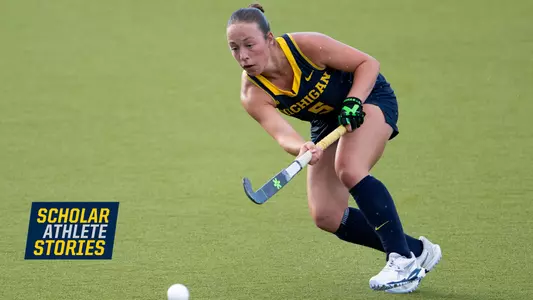
11/3/2026 2:45:00 PM | Field Hockey
Continuing the series that began in 2016-17, each week MGoBlue.com will highlight a Michigan student-athlete and their academic pursuits. These are our Scholar-Athlete Stories.
By Gerardo Tinajero
For University of Michigan field hockey sophomore Grace Hunter, the start of a busy week often begins with a piece of paper and what she calls her "mega to-do list."
Engineering assignments, upcoming exams, field hockey practices and everyday responsibilities all find their way onto the page. It is a simple habit, but one that has become essential as Hunter navigates the demands of being both an engineering student and a Division I athlete.
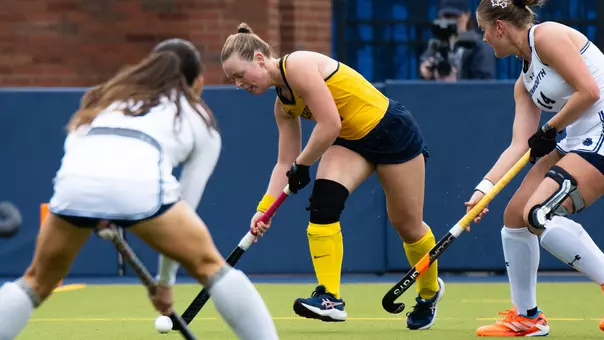
That commitment to preparation has become especially valuable during her second year in Ann Arbor. Along with managing a challenging academic schedule, Hunter has embraced a new role on the field, transitioning from forward to defender and earning greater responsibilities for the Wolverines.
While engineering and field hockey may seem like two different worlds, Hunter has discovered that success in both often comes down to the same qualities: adaptability, attention to detail and a willingness to solve problems.
"Engineering, more than anything, is a mindset," Hunter said. "I think more than anything is knowing to look at a situation and see, how can I solve this? And how can I solve it to the most efficient and most logical way possible?"
For Hunter, that mindset has become central to her growth, helping her find confidence in the classroom, embrace a new position on the field and discover what she is capable of achieving at Michigan.
Growing up, Hunter enjoyed math and science, particularly subjects that allowed her to work with her hands. Her interest in solving problems eventually led her to explore different career paths.
When considering colleges, Hunter wanted a university that allowed her to pursue a demanding academic program without compromising her athletic ambitions. Michigan stood out for its engineering, a field she believed would continuously challenge her and let her explore different career paths.
Equally important was the culture she experienced within the field hockey program.
"It just felt like it was the first time where I felt like I was on a team and I had, you know, 28 best friends," Hunter said. "We are a family on the field, and we're a family off the field."
That support has played an important role in helping her navigate the transition to college, where balancing academics and athletics quickly became a lesson in time management.
During her freshman year, she learned to become more intentional with her schedule, organizing assignments, exams, practices and travel around the limited time available each day.
Hunter now describes herself as a "Google Calendar girl," relying on detailed schedules and weekly to-do lists to manage her responsibilities. Breaking down larger tasks helps her approach demanding weeks with greater clarity.
"I think budgeting my time really well and being intentional about my time has been definitely the biggest challenge for me," Hunter said.
That commitment to organization has already produced results.
After adjusting to the academic expectations of college during her first semester, Hunter set a personal goal of earning straight A's during the spring semester of her freshman year. Through preparation and consistent effort, she accomplished it.
Hunter's achievement was particularly meaningful because it reinforced the confidence in her ability to succeed academically while competing at the collegiate level.
Her sophomore year has continued to test that discipline. During one demanding stretch, Hunter faced three exams in five days while also preparing for two Big Ten matchups against Iowa and Northwestern.
Rather than allowing those responsibilities to discourage her, she has worked to approach each challenge as an opportunity to develop.
"I knew I was going to come in as engineering," Hunter said. "I knew I was going to be faced with a lot of challenges."
That willingness to embrace challenges has also shaped her development on the field.
After contributing as a forward during her freshman season, Hunter transitioned to defender this year. While the position required a different approach, she was able to draw on her previous experience playing multiple positions in high school and club field hockey.
Understanding the game from both perspectives has become one of Hunter's greatest advantages.
"I think playing forward makes you a better defender, and playing defender makes you a better forward because you're able to observe more," she said.
Having experienced the responsibilities of both positions, Hunter has developed a greater understanding of what her teammates need from one another. Her time as a forward helps her anticipate attacking situations, while her experience as a defender has broadened her perspective on how plays develop.
That adaptability has allowed her to approach the transition with confidence.
During the offseason, Hunter focused on improving her individual skills and preparing for a larger role. By preseason in August, she began noticing the results of that work.
One moment stood out during a competitive drill called "Queen of the Court," where players compete in one-on-one rounds across a series of grids.
As she completed defensively, Hunter recognized a change in her confidence and decision-making.
"I remember playing defense, and I just felt so calm and confident in my decision-making," Hunter said. "I felt like I had clarity in the decisions I was making."

That confidence has translated into increased opportunities during her sophomore season, including earning starts and taking on a larger role within the team.
These opportunities represent the preparation and effort required to contribute at a higher level.
"I want to ultimately, I want to make an impact on the field," Hunter said. "And I knew I had it within me, but you got to work up to it and you got to earn it."
As she continues developing as a defender, Hunter has found that the problem-solving skills she uses in engineering translate naturally to field hockey.
In one engineering course, Hunter worked with classmates to build a functioning weather balloon. The project required collaboration, testing and adjustments as the group worked to improve its design.
She recognized a familiar process.
"We would test the weather balloon, see what went right, see what went wrong, and immediately come back together after and say, 'OK, how can we fix this?'" Hunter said.
That same process unfolds during field hockey practices, where players evaluate drills, communicate with teammates and identify ways to improve.
Hunter has also learned that successful problem-solving does not always require dramatic changes. Sometimes, the smallest adjustment can make the greatest difference.
In engineering, a single incorrect character can prevent a coding program from working properly. On the field, a slight change in body positioning or the pace of a pass can influence the outcome of play.
"I think sometimes it is just you need the tiniest adjustment, whether it's your body positioning or the pace of the ball that you're passing," Hunter said.
Those experiences have strengthened her attention to detail and reinforced the importance of collaboration, both in the classroom and on the field.
Throughout her journey, Hunter credits the people around her for helping her manage the demands of being a Michigan student-athlete.
Her coaches have supported her academic communities, while Michigan's academic resources have provided opportunities for tutoring and assistance when balancing classes with competition. Her teammates have offered encouragement and understanding during challenging weeks, and she remains closely connected with her family.
"It's just everyone wants to help everyone," Hunter said.
That environment has given Hunter the confidence to continue exploring her interests beyond field hockey.
Although she has not yet finalized her engineering specialization, she is considering materials science and engineering with a growing interest in product development.
After participating in a career venture through Michigan's Graham Family Athletic Career Center, Hunter began exploring opportunities in athletic apparel and footwear development.
As someone who has spent much of her life competing in sports, she is particularly interested in the possibility of using her engineering education to improve equipment for future athletes.
"I just would love to innovate for the next generation of athletes and make their performance the best that it can be, because equipment matters," Hunter said.
The opportunity to combine engineering with athletics would be a meaningful way for Hunter to give back to a community that has played an important role in her life.
As Hunter looks ahead to the remainder of her Michigan career, she hopes to continue growing academically, earn greater responsibilities on the field and develop into a leader her teammates can depend on.
But her goals extend beyond grades, playing time or future career opportunities.
Hunter wants to leave Michigan knowing she gave everything she could to the university and the people who helped shape her experience.
That commitment reflects what Hunter believes it means to be a Michigan woman.
"I think one of our core values is pursuing excellence," Hunter said. "And I think that is what it means to be a Michigan woman. It means to exemplify our core values, to pursue excellence, and to be grateful for it all, putting the team first."
From learning to manage a demanding engineering schedule to finding confidence in a new position, Hunter has come to appreciate how each challenge contributes to her development.
And while she recognized there is still more to accomplish, she is proud of the progress she has made.
"I feel like I'm growing into the kind of person that I want to be," Hunter said.