Scholar Stories: Cardenas Finding Purpose Through Movement Science, Mental Resilience
2/26/2026 11:00:00 AM | Men's Swimming & Diving
Continuing the series that began in 2016-17, each week MGoBlue.com will highlight a Michigan student-athlete and their academic pursuits. These are our Scholar-Athlete Stories.
By Nora Fairbanks-Lee
For sophomore diver Julian Cardenas, his decision was easy. The University of Michigan was his first official visit, and after spending time with the team and then-diving coach Mike Hilde, he did not need to visit anywhere else.
"Michigan was my first official visit, and after having my visit at Michigan with my old coach, Mike Hilde, I committed on the spot there," he said. "I really enjoyed the team nature."
The combination of culture, camaraderie and proximity to his hometown of Rockford, Mich., made Ann Arbor the perfect fit.
After arriving on campus and learning about the movement science major within the School of Kinesiology, everything aligned. Cardenas has always envisioned himself working with people. His interests lie in understanding biomechanics, anatomy and how the body functions, and working toward becoming a physical therapist.
"I always wanted to go into something where I was working with people," he said. "When I learned about movement science, it just perfectly fit what I was looking for."
His first class, Movement Science 230: Human Musculoskeletal Anatomy, solidified his passion for physical therapy, even though it had its share of difficulties. The coursework is rigorous, often requiring students to memorize every bone and muscle and synthesize complex systems quickly. But instead of feeling overwhelmed, Cardenas embraced the challenge and felt energized by it.
To deepen his knowledge, Cardenas is taking Physiology 201: Introduction to Human Physiology. In this course, he has gained knowledge of the importance of maintaining homeostasis -- a self-regulating process by which biological systems remain balanced in changing environments. Through organ systems and body mechanics, Cardenas has developed a new awareness of how his own body performs under stress and adjusts accordingly to improve his performance.
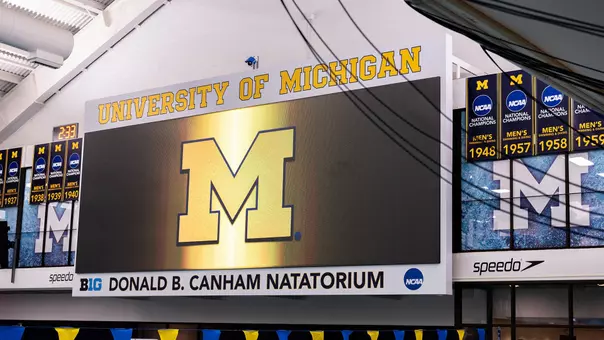
"At (Canham) Natatorium, we have always had student trainers who are all going through the same process as me right now," Cardenas said. "And there are some taking similar classes, so they can give me an in-depth breakdown because they know that I'm going through the same thing and can explain better."
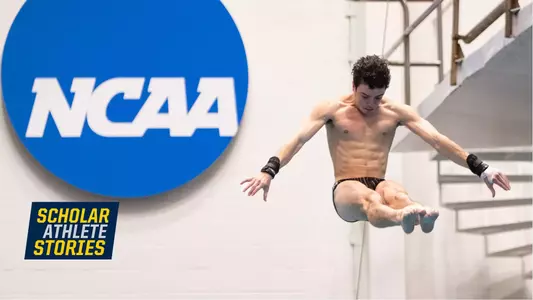
Cardenas started diving at 10 years old during the summer when his parents first introduced him to a diving board. Since then, he has competed in various clubs and has not looked back, even helping the coach when he is back at home.
"Ever since I was diving in the club, I was kind of coaching and helping people. I also had a lot of injuries in the club and knew my way around diving," Cardenas said. "I found a lot of joy in just giving my advice on what helps me. And if they tried it, when it worked for them, it was really nice to hear. I love coaching young kids and watching them grow. And it's fun going back home and seeing how much better they've gotten."

His passion for physical therapy started during his junior year of high school when he suffered a back injury that required months of rehabilitation. Captivated by the problem-solving nature of the industry, something beyond recovery was sparked.
"I remember telling him where it hurt, and he'd say, 'Try this movement.' Then he'd explain exactly what was wrong and how to fix it," Cardenas said. "Being able to understand the problem and then actually help someone really stood out to me. I still text his physical therapist if I have questions."
The experience reshaped how he viewed setbacks. Rather than seeing injury as purely an obstacle, Cardenas began to see it as an opportunity to learn about the body, resilience and helping others navigate similar challenges.
While Cardenas' academic interest focused on the body, his growth as an athlete centered just as much on the mental aspect of diving.
"Diving is largely a mental sport because, obviously, you're training all the time. It's just being able to do it under pressure and trusting your body. I think that's been the hardest part for me -- I'll try to be perfect, but then be tense on the dive," Cardenas said. "I'm learning the mental side right now and how to correct that. And it's really helped me to nail my dives every round."
The growth has translated to performance. At midseason meets last year, Cardenas began outperforming competitors, showing a tangible difference as his physical preparation and mental resilience aligned at the perfect time. Now, heading into the postseason with this week's Big Ten Championships, Cardenas feels more prepared than ever.
"I feel better than I have before," he said. "I'm excited. I started realizing I could actually be a player in the game."
As Cardenas looks ahead to a career in physical therapy, he sees that his academics and athletics are inseparable. The same principles that guide his dives -- preparation, resilience and balance -- are reinforced in the classroom and are shaping the foundation of his future.