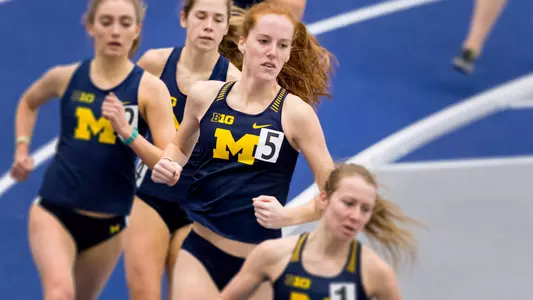
Alice Hill: An Unexpected Steeplechase Star (Part 2)
7/26/2018 1:00:00 PM | Women's Track & Field
Over the span of a single month, rising sophomore Alice Hill of the University of Michigan women's track and field team went from having never run the 3,000-meter steeplechase in June to finishing seventh at the IAAF World U20 Championships and among the fastest teenagers in the event in American history. This is the second entry of a three-part, long-form feature chronicling not just that meteoric month, but also the unique circumstances in the preceding years, months and weeks that led to her rise.
Part one of the story can be found here.
We begin part two of Hill's story during her first year at Michigan, during the 2017-18 academic calendar...
After building an aerobic base for herself by surviving her first-ever cross country season and during an indoor campaign that saw her make her debut in the mile -- a race doubled in distance from her signature 800 meters -- Alice Hill's winter training for the 3,000-meter steeplechase was going well enough.
Once or twice a week throughout the winter, University of Michigan distance coach Mike McGuire would have her join in with eventual All-American steeplechasers Claire Borchers and Sarah Zieve on hurdle workouts. Given Hill's hurdle credentials from high school as a three-time top-10 State Championships finisher, "I wasn't too concerned about that aspect of it," she said.
But once the spring rolled around -- in the calendar sense of the term, only, as the state experienced colder-than-average temperatures throughout much of March and April -- she was finally able to get outside and attempt the water jump.
It did not go well.
"I was wearing full leggings and gloves and stuff, so, I don't know if that was the best way to do the steeple and the water barrier for the first time," Hill said. "It did not feel smooth at all. I didn't feel good and it must not have looked very good because Coach McGuire said, 'Yeah, yeah, we're going to have to work on this.'"
"I was presumptuous with thinking she was going to have no problem with the water pit because she was such a good hurdler in high school," McGuire said. "When we first went outside to do it, it just wasn't happening. I wasn't comfortable rushing her into it during the collegiate season."
A few weeks passed. While McGuire and much of the team was out west competing at the Arizona State Pac-12/Big Ten Challenge on the weekend of March 23-24, Hill -- whom McGuire was planning to redshirt for the spring to further develop -- was back in Ann Arbor starting to get the hang of the steeplechase.
Her workout that week went just well enough that, after getting a debrief of it, McGuire made the call to pull the redshirt from Hill and make a go of it for the 2018 outdoor season.
Hill's first outdoor meet was to be the Battle of the Blues at Duke on April 6, but whether she would actually make her steeplechase debut was up in the air.
"I'd done some steeple practice during the week and (McGuire) was still not really sure what I was going to run literally until we arrived at the meet," Hill said. "And he said, 'Yeah, I don't think you're ready with the water barrier quite yet for race, so we're just going to have you in the 1,500.'"
So, instead, Hill made her collegiate debut in the 1,500 meters, clocking a respectable 4:28.01 for fifth place overall in what was one of the first track events of the meet.
To this point she had only once in her career run a longer race: a mile that she ran unattached (not wearing a Michigan uniform) at a December indoor meet at Grand Valley in 4:48.89. For Hill, the 1,500-meter/mile distance was nearly as foreign to her as the steeplechase.
"With the 800, it's like you've barely started and then it's the kick to the finish," Hill said. "Whereas in the 1,500 you're a lot more conscious about what you're doing and about how much farther you have left to run and about who's around you and how much the distances are between the different packs.
"Ultimately, I think I just picked someone on the team and just followed them around. Then in the last lap, tried to outkick them at the end."
Just when Hill thought that was that for her outdoor debut, McGuire found her after the race and uttered the last phrase any track and field athlete wants to hear on meet day.
"Afterward," Hill recalled, "He's like, 'I've got a surprise for you.'"
That was when she learned that she would be running the first 1,000 meters of the 3,000-meter steeplechase -- essentially a full third of the race -- toward the end of the meet.
Mixed emotions ensued.
"At first I was really shocked and terrified," Hill said. "And then I thought, 'OK, yeah, I can totally do this.'"
After finally psyching herself up to run and with just a few minutes left before the start of the race, McGuire sent Hill out for a brief warm-up just to get the feel of the barriers and the water pit.
"I go to do the first one and I think my foot slipped off the barrier," Hill tried to recall. "I don't quite remember what happened. I just literally belly-smacked into the water pit, and I grazed up my knees.
"Right after that, Coach said, 'No, you're not running that. I'm taking you out right now.' So, that was my only experience during the season of almost running the steeple."

For the remainder of the collegiate outdoor season, it was all about the 1,500 meters for Hill. She would go on to run a strong 4:24.63 at that distance at Stanford -- a time that ultimately made her the fifth-woman-out from qualifying to the NCAA postseason -- and take 15th at the Big Ten Championships.
"She's accomplished in the 800m and 1,500m, so we just said, 'We'll run her there for now,'" McGuire said. "Then we did delve into the steeplechase in that period after the Big Ten meet and it started to come around."
Hill continued to work with McGuire on the steeplechase. Her first practice back from Duke did not go very far in assuaging her debacle in Durham, as she once again faceplanted into the water.
"When we first started, I remember thinking, 'Yeah, water barrier? No problem,'" Hill said. "And then from the very first time looking at it from down the track I was thinking, 'Oh my God,' it was so much scarier than I expected it to be. And I think it probably didn't help that I had faceplanted at Duke and then I think I faceplanted the next time I practiced it as well. So I was a little bit scarred after that."
Seeing Hill struggle to slowly grow more comfortable with the water jump, McGuire recruited head coaches James Henry and Jerry Clayton to put in some time with her on the more technical aspects of clearing the barriers.
"After several weeks of just doing little bits of it, it became more natural, especially when we did other drills that mimic it," Hill said. "And I proved to myself that I wasn't going to slip every single time I did it."
McGuire and the staff noticed the uptick in her comfort level, as well.
"Coach Henry did a great job -- and Coach Clayton was involved a little bit, too -- with some different things we worked on from a biomechanical standpoint," McGuire said, "And I handled the workout end of it, and we all could see it coming together. From a training standpoint, I definitely knew she was ready. She was interfacing workouts with Claire and Sarah. She was right there in workouts with her two veteran teammates."
While Hill's collegiate season officially came to an end at the Big Ten Championships, she watched teammates Borchers and Zieve continue their steeplechase exploits from the conference level all the way to the national level.
Borchers and Zieve took gold and bronze at the Big Ten meet at Bloomington, Indiana, and went on to earn All-America honors at the NCAA Outdoor Championships. Borchers followed up her Big Ten title with a mad dash to the finish at nationals that put her fourth overall in the final, while Zieve developed a signature late-race kick that delivered her to a 16th-place finish at NCAAs.
More and more throughout Hill's post-Big Ten Championships portion of the season, she started linking up frequently with Borchers and Zieve for workouts. As that redshirt senior duo was building on the foundation of what would become an All-American postseason run, the neophyte Hill was just laying a foundation that would carry her through the USATF Junior Championships and, ultimately, the world championships.
"I was watching them and I thought, 'You know, if they can do it, if they can keep going and make it on to the next round and compete with the best people in the country, I can do this,'" Hill said. "I trained with them, I can definitely do this."
It was during this period that Hill's drive to do the steeplechase during the post-collegiate season was forged -- despite a year earlier having been completely unaware of such opportunities.
"I'd never heard of junior nationals. I didn't know U20 worlds existed," Hill said. "So yeah, it was only when we were towards the end of outdoor season when Coach McGuire said, 'Yeah, you can train for this and we won't have you run steeple during the rest of the year, but you can run it at this meet at the end of the year.'
"And I was thinking, 'OK, it's just another meet.' And then before that meet he asked, 'Do you want to go to Finland?' And I said, 'Finland?' He said, 'Yeah, you can qualify from this meet to go to Worlds.' I was like, 'OK, I'll give it a go.' I didn't think it would happen."

Photo courtesy of Milesplit
Just over two months removed from Duke, and a month clear of her last competitive race at the Big Ten Championships, Hill found herself only just recently comfortable with the steeplechase but nevertheless on the starting line for her proper debut at the USATF Junior Championships on June 15.
In sweltering heat nearing 90 degrees on the same track in Bloomington that hosted Big Tens, Hill was surrounded on the starting line by competitors who had all either steeplechased before or had extensive experience with track races of at least 3,000 meters.
Hill was the only one in the field about to check both boxes for the first time in her career.
"I think because I thought it was the last race of my season, I was just thinking, 'You know what? Seven laps and I'm done. I'll be on break,'" Hill said. "I wasn't too concerned. I mean, I was nervous, but it's not like I had a time I felt the need to beat. I don't have any previous expectations. I'll just go out there and run. See what I can do."
Though much of the race itself is a blur for Hill, both she and McGuire remember the dreaded first water jump -- without any opportunity on the day of to practice it -- being "a bit shaky," as McGuire described it, but she soon settled in comfortably.
"I remember my strategy was to just follow Kristlin Gear from Furman, the girl I ended up going to Worlds with, and see if I could hang on," Hill said. "I remember at the beginning of the race I felt slow because I'd never run a 3,000 before. So I was thinking this is easy. I'll just hang with them and then I'll just outkick everyone at the very end."
Hill and Gear stayed at or near the front of a pack that shrunk from eight women after the second of seven laps -- shortly before Hill watched then-leader Emma Wilson wipe out in the water pit directly in front of her -- to six by the end of five, at which point the race truly began.
During the sixth lap, the group went from running slower than 90 seconds per lap to just under 90 seconds, enough to shed all but Hill, Gear and Alex Harris of Villanova from the lead pack.
"But then we hit the last lap and I was thinking, 'Oh my God, it's no longer easy,'" Hill said. "I think with two laps to go, probably, I had kind of tried to make a move into first. I think I did make a move into first. But then on the last lap Kristlin kicked past me and I was trying to hang on with her, but she was definitely getting away from me."
After a final 83-second lap, Hill crossed the line runner-up to Gear by three seconds in 10:31.07.
The run was impressive in its own right -- after all, in her first-ever steeplechase she had gone fast enough to move to No. 10 in school history -- but McGuire saw the potential it truly held.
"I looked at it and I thought it was misleading," he said. "It was a really good first time, but she went head-to-head with a woman who ran 9:52 during the collegiate season. She was fitter than 10:31, so moving forward that's what we sold her on, that you're ready for a big breakthrough here."
By virtue of finishing top-two in the race, her performance had presented her with the opportunity to represent Team USA at the IAAF World U20 Championships -- that meet she had never heard of a year earlier -- in a month's time in Finland.
But it also presented her with a hard choice, despite the allure of representing her country and unlocking her steeplechase potential.
"I was looking forward to studying abroad so, coming in, I wasn't planning on going even if I did make it," Hill said. "So it, because I barely knew anything about Worlds or anything, seemed to me like a no-brainer that I would just do the study abroad.
"So then once I did qualify I had to actually think, really think, about what I wanted to do. It was so hard. I've been so, so excited for my study abroad and I've been waiting so long for it. It's only two weeks before at this point, so it's really close."
Able to secure a last-minute deferment of her trip until next summer, Hill made the choice to suit up in the Red, White and Blue for Team USA on the world stage.
"It was tough, but it was obviously the right decision in the end."
And just like that, just one steeplechase race into her career, she was off to Finland to take on the world.
Alice Hill's story concludes on Friday (July 27) with her heading off to Finland to take on the world's best and making a name for herself in the process.