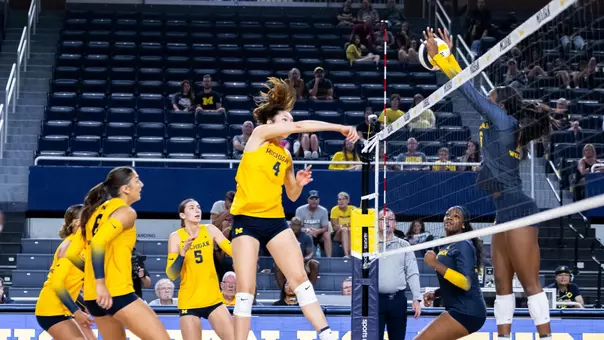
Q&A with Head Coach Mark Rosen
10/31/2001 12:00:00 AM | Volleyball
A Weekly Visit with the Michigan Volleyball Head Coach
On the Blue Aces' "Beat the Buckeyes" bus trip and the possibility of future bus trips ... "Well, it definitely is a new experiment for us. We're excited about trying it for the first time, and we're getting a decent response. I'd say we probably have about 20 people who have chosen to go on the charter so far. We'll just have to look at it after this year. Certainly it'd fun to do it for a match at Notre Dame. It really needs to be a match that we can get to in a day and not have to stay overnight, whether it's Michigan State or Notre Dame or Ohio State. Certainly we'd like to see if it works well, and then we could do it in the future."
On the new rules regarding where a ball can be played ... "You can play the ball anywhere away from the court, as long as you don't go into what they call a "non-playable" area which would be the bleachers, behind the benches, or behind the scorers table. If you're going into the bleachers, as long as you have one foot still on the floor, you're alright. Our kids are going to try to pursue the ball as far as they can.
"We do have a new experimental rule this year called the pursuit rule. It used to be if you're pursuing a ball that comes from your side that goes outside of the court and across the extension of the center line then the ball was immediately dead. Now that ball is still alive and you can pursue over to the opponents side of the court as long as you and the ball are outside the court and you bring it back to your side. It doesn't come into play very often, maybe four or five times this season, but I like it because it opens up for more pursuit and long rallies. Our players are going to play the ball as far as they can and sort out later whether it's legal. We always tell the players to play until the whistle's blown, and let the referee decide when it's dead."
On the trend toward "beach digs," setting the ball directly off an attack, in college volleyball... "Whether you like it or not, it's here to stay. When they started to loosen the rules about eight to 10 years ago, they gradually kept loosening them. About two or three years ago they really loosened things up in order to play things more overhead. I don't see the sport going back in the other direction.
"We've started to train our players a lot more to use their hands. It's really basically setting the ball when it's driven hard. It used to be when the ball was hard driven or off the serve you weren't allowed to set the ball. They'd immediately call a lift or a double hit. Now it's actually against the rules to call a double hit on the first team's contact. The referee can't call a double hit as long as the ball is hit on one attempt. The one thing they can call is a lift, which is when the ball comes to rest. This can happen when you don't get the ball out of your hands fast, but even that the referee's have become much looser on calling that.
"We've really tried to talk to our kids about using their hands because you can control the ball a lot better by playing the ball above your head. If you can play the ball above your head and control it, that's great. The purists - and I'm one of those - didn't really like that change, but it's here and part of the game. You really have to change and evolve with the rules. I think our sport's still evolving, and I think that's fun."
On which foot a player should jump off of on an attack... "It depends on whether you use a three-step or four-step approach. I think the biggest thing isn't about where you start your approach, it's how you finish your approach. We always talk to our right-handed players about finishing their last two steps being right-left. The reason is because if they plant their right foot then their left foot, it opens their hips up to the right side of their body and allows for rotation. It's just like if you want to throw or pitch a ball. You want to be able to rotate your hips and shoulder, and then your arm swing follows that. If you finish your approach with a left-right, then your hips are already turned to the left so you have no room for rotation
"If you reverse that for a left-handed player, they want to finish their approach left-right so that it opens up their hips to the left side of the body. Then they can rotate as they swing to the right. It takes a lot of pressure off your shoulder. It allows you to hit the ball harder, and it allows you to hit the ball with more control.
"So, for a right-handed player, the last two steps should be right-left; and, for a left-handed player, the last two steps should be left-right. The next thing is where you want to start from. If you do a three-step approach and you want to finish left-right, then you want to start with your right foot. So it'd be right-left-right. If you're going to do a four-step approach and you're left-handed then you'd want to start with your left foot, and it'd be left-right-left-right."
Past Q&A Sessions with Coach Rosen
Contact: Jason Gerdom (734) 763-4423