11/18/2026 10:59:00 AM | Women's Soccer
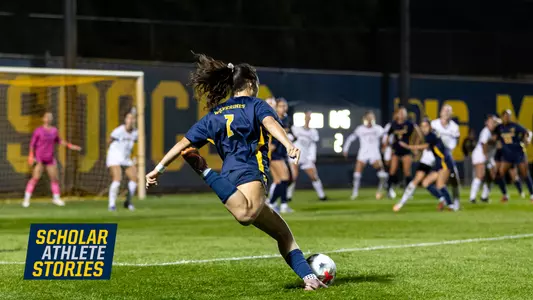
Continuing the series that began in 2016-17, each week MGoBlue.com will highlight a Michigan student-athlete and their academic pursuits. These are our Scholar-Athlete Stories.
By Margaret Meredith
For Beanie Harshe, the University of Michigan was always a familiar place. Growing up in Dexter, she watched four family members find their places in Ann Arbor, knowing Michigan was an option but unsure whether it was right for her.
With so much family history tied to the Maize and Blue, Beanie initially thought she wanted to step outside her comfort zone and do something different in college. Eventually, she realized she didn't have to go somewhere else to create a different experience. She could make her Michigan career her own.
"At first I thought that I wanted to get away from Michigan and be different and do something that my family members hadn't done," Beanie said. "But Michigan is such an incredible school because there are so many different paths you can take."
Rather than being defined by her family's history, she discovered that U-M offered the opportunity to create an experience entirely her own, beginning with her decision to graduate from high school a semester early. Having seen others take an accelerated path, she realized it was not only something she wanted to do, but something she could do.
"Nothing that I was going to accomplish in high school was really a part of my long-term journey," she said.

Beanie had discovered soccer at a young age, and when she realized she could continue playing at the Division I level, the question became where she would pursue that passion. After committing to Michigan, she worked with her high school counselors, the coaching staff and Michigan academic advisors to determine whether an early transition to college was both logical and feasible.
Through careful planning and an adjusted schedule, she graduated from high school and enrolled at Michigan in January 2024. Rather than focusing on the challenges of taking an unconventional path, she embraced the possibilities. Why not give herself an early start? Why not see where the opportunity could take her?
But even a transition close to home comes with uncertainty. Although committed to U-M, Beanie did not learn whether she had been admitted to the university until mid-December, leaving just weeks to prepare for her move to Ann Arbor.
She recalled wondering, "It's December [...] am I going to be living at home next month, or am I going to be in college?"
Within weeks, she made the move to Ann Arbor and began a new chapter of her life, one she would get to shape for herself.
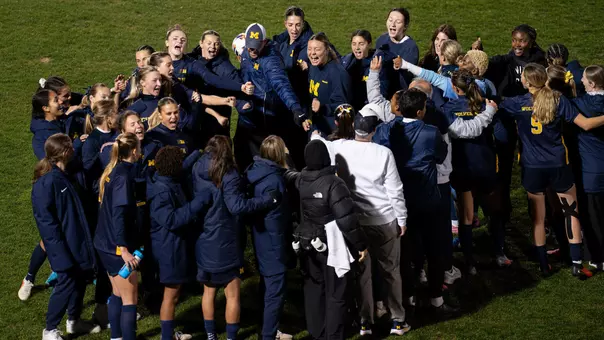
The transition to college can be challenging, especially in the middle of an academic year. But Beanie found support in her teammates, including a close friend who enrolled early alongside her. The two became the first players in program history to enroll early. She initially wondered whether joining an established team would make the transition more difficult or leave them feeling like outsiders. Instead, they found the opposite.
"They were all so awesome and invited us to everything they did, and really helped make the transition so much easier," Beanie said.
The support she found from her teammates was just the beginning of the resources and relationships that would help shape her Michigan experience.
When Beanie arrived at Michigan, she was unsure what she wanted to study. Rather than rushing into a major, she used her early semesters to explore different subjects and discover where her strengths and interests aligned. She took a variety of introductory courses, including computer science, before finding her direction in economics.
"I was just taking lots of classes and seeing what sort of interested me," she said. "And Econ was kind of at the heart of what I liked and what I was good at."
After choosing her major, Beanie worked with her academic advisor to map out a plan that would allow her to complete her degree ahead of schedule. Once again, she embraced the idea of "why not?" and the opportunity to challenge herself, ultimately graduating this past summer with a 4.0 GPA and Highest Distinction.
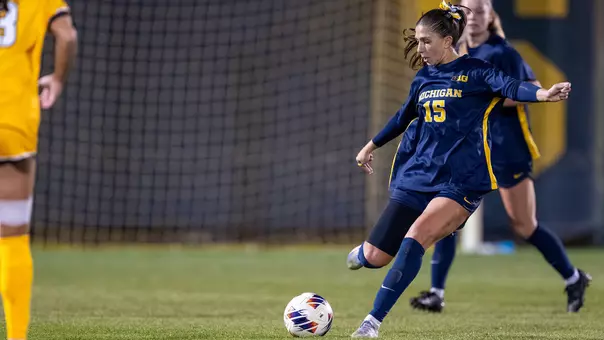
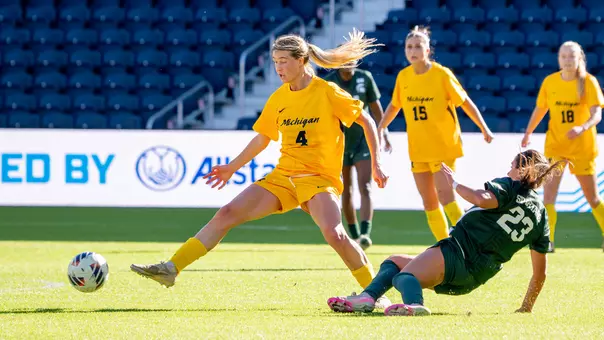
Beanie enjoyed studying economics and loved being part of the women's soccer team, but her time at Michigan has always been about more than excelling on the field and in the classroom. She continued looking for ways to forge her own path, follow her passions, take ownership of her education and explore everything the university had to offer.
That same approach influenced her decision to continue her education. With remaining soccer eligibility and a home in Ann Arbor, Beanie found another opportunity to build on her Michigan experience by pursuing a Master of Management through the Ross School of Business.
It was not something she had envisioned for herself growing up, but rather a natural next step that allowed her to pursue new opportunities while remaining at Michigan.
"It was really more, 'I want to be at Michigan. How can I be at Michigan?' rather than like, 'I'm dreaming of getting a master's degree,'" Beanie said. "But it's been pretty cool, so I don't regret it."

While her academic accomplishments are a major part of her story as a Wolverine, Beanie's experience extends well beyond the classroom and soccer field.
During her time on campus, Beanie has made an effort to get involved in the Michigan community, take advantage of opportunities available to student-athletes and discover ways to give back. In addition to competing with the soccer program, she serves as the NIL outreach coordinator for the Student-Athlete Sustainability Initiative and represents the soccer program on the Student-Athlete Advisory Committee (SAAC). She has also participated in community outreach efforts, including hospital visits and other department initiatives.
For Beanie, getting involved started with once again asking herself, "Why not?"
"At Michigan, there's so, so many opportunities, but it's easy for some of them to kind of fly under the radar," she said.
Her involvement with the Student-Athlete Sustainability Initiative, for example, began with a desire to support a teammate who started the program. What began as an opportunity to help a friend became another way to connect with student-athletes across the university.
Through SAAC and her other activities, she has met people with different interests and ambitions, building relationships and learning from experiences outside her own team while continuing to forge her own path at U-M.
"Just saying yes to those things that are so easy to say no to has really opened a lot of doors for me," Beanie said.
Forging her own path also has meant learning to manage her schedule and make time for herself, something that is not always easy as a student-athlete. Between soccer, academics and extracurricular commitments, Beanie has learned the importance of being intentional with her time while also giving herself grace.
"I feel like I had so much more time to just chill in high school, and now it's kind of like I have to be more intentional about setting aside time to do what matters to me," she said.
Despite the demands of her schedule, she views her involvement not as a sacrifice but as a privilege. She recognizes that when she spends time doing things she genuinely cares about, finding the motivation to show up becomes much easier.
"If you're spending your time on stuff that you care about, it's not too hard to get up for it," she said.
The opportunities that have shaped Beanie's Michigan experience have rarely come from following a predetermined path. From graduating early and discovering her academic interests to continuing her education and getting involved beyond the soccer field, she has learned to embrace the possibilities in front of her rather than fear what might come next.
Looking back, her advice to students beginning their own journeys is to be ambitious, set big goals and not let the fear of failure keep them from pursuing something new.
At a place like Michigan, she believes there is no limit to what students can accomplish if they are willing to take that first step.
And for Beanie, that first step has often started with a simple question: Why not?