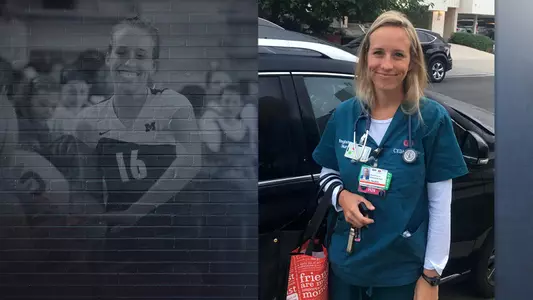
Former Wolverine Ryan Making an Impact in Los Angeles During Pandemic
4/30/2020 10:00:00 AM | Volleyball, Features
LOS ANGELES, Calif. -- Usually, a drive to the beach while navigating Los Angeles traffic is an endeavor that requires plenty of time. However, at the beginning of March, as University of Michigan volleyball alumnae Kerry (Hance) Ryan and her family were making their way to visit the Pacific Ocean, it started to hit them that there was something big happening.
"We were heading to the beach the weekend before the stay-home order came through," said Ryan. "Los Angeles has traffic at all times, and then this day there was absolutely none. My husband (Charlie Ryan, U-M class of 2009) and I looked at each other and thought, 'Maybe we shouldn't be doing this.' It usually takes us 35-40 minutes, and we were just cruising. It was obvious a lot of people were staying home, and we actually turned around and went back."
Ryan finished her career as a Michigan volleyball player in 2008, but felt a pull towards nursing that kept her in Ann Arbor a while longer. The Los Angeles native graduated with an undergraduate degree in psychology in 2009, but returned to campus to pursue a degree as part of the second-degree nursing program, which she received in 2011.
Since graduation, Ryan has been working at Cedars-Sinai Medical Center in Los Angeles on the bone marrow transplant floor, usually working with cancer patients going through the transplant process and chemotherapy treatment. Because of the COVID-19 pandemic, however, things have changed.
"It's a completely different floor right now," said Ryan. "I've been in a very specific situation for my entire career as a nurse, but now we have a lot of patients dealing with psychiatric issues and general pain-management cases. The hospital has tried to keep the COVID-possible patients on certain floors, but we still get patients that are potential COVID patients (have been tested, waiting on results). We might have patients on specific precautions now, and even though they might not be positive, we are wearing all of the protections. Though not as many as the all-COVID floors (32 beds), we've still gotten quite a few possible cases. It's become a different kind of nursing."
Being able to adapt on the fly is part of what made Ryan a successful student-athlete at Michigan. In her four seasons with the Maize and Blue as a defensive specialist and libero, Ryan accumulated 1,286 digs and had a career digs-per-set average of 2.74. She was part of the first U-M volleyball team to host the NCAA Tournament in 2007, which also advanced to the NCAA Regional for the first time in program history, and helped the Wolverines to 84 wins and a .632 winning percentage in her career.
"Having been an athlete in an organized sport for most of my life, I've become good at things that are important in being a good nurse, too," said Ryan. "I am used to being routine-oriented, being on time, showing up where I'm supposed to be and adapting to new situations. When you're playing on the court, you might have scouted your opponent and they had a crazy jump serve, and then all of a sudden they're on the ground serving. You're able to adapt because over the course of your career as an athlete you have to in order to be successful.
"As a nurse, I have to be able to roll with it. There's a lot of anxiety around everything going on right now. I feel the anxiety to an extent, but it doesn't get me down. I'm ready to fight this thing."

The team-first mentality Ryan developed through years of sports also is something that now carries over into her everyday life.
"I'm so used to a team aspect, and my floor has been so wonderful," said Ryan. "I see them as my teammates. Comparing it to volleyball, if I'm passing a ball and shanking pass after pass, I'll look at my teammate and say 'OK, you take this next one,' and I feel like that in nursing.
"We're all in this together. You have a COVID-possible patient? Let's go in together, we can do this. Nursing is all about teamwork. I've been together with a lot of these nurses in this unit for 10 years now, and we know what each other needs. We know we can depend on the others to help us. It's the biggest correlation back to being an athlete."
Los Angeles and its surrounding areas have been hotspots for activity during the COVID-19 pandemic, and the new normal has forced frontline workers to make changes in every part of their lives. For the Ryans and their young family, some of the most intense changes have come at home.
"I work 12-hour shifts, leaving at 6 a.m. and getting home at 8:30 p.m." said Ryan. "We aren't seeing my parents right now who are usually the caretakers for my kids, but my dad has asthma and I'm not willing to risk that. Charlie is taking care of the kids all day most days, having to work on a lot of his work things during nap time. Then he works a lot of the night and tries to catch up and has to do it again the next day."
Ryan is considered a part-time nurse, usually required to work two 12-hour shifts a week. However, things have changed recently and when her nursing teammates have needed her, she has been ready for the call.
"It's not every day, which is part of what's great about being a nurse. But right now, it is a degree of uncertainty plus long days for my husband. Preparing three meals and having to handle nap time, bath time, bed time ... it can be a challenge with the little ones. It's definitely a tough task, but he understands that we're in a very unique situation right now, and the hospital needs me and this is my profession."

The Ryan family (from left): Madelyn, Kerry, Charlie and Patrick
COVID-19 has tested the resolve of many during these times, and Ryan has had to not only see some of the toughest moments firsthand, but provide comfort to those who are going through the battle of their lives by themselves.
"The hardest part has been seeing all of the patients alone," said Ryan. "Visitors are not allowed in the hospital, and I'm used to my patients being in the hospital 20 to 30 days and having a family member with them through the chemo and transplant process.
"Right now, we have very, very sick patients and visitors aren't allowed. I think that's been the hardest part to watch, and unfortunately a lot of patients are passing away without their loved ones. A lot of them are getting chemo without any support with them ... it has been difficult to watch. FaceTime has been extremely important for those moments."
One thing that stands out in a talk with Ryan is her compassion for others. Working on a hospital floor with cancer patients certainly presents opportunities for that to shine through.
"So many people are alone right now, and I'm not sure we think and talk about that enough," said Ryan. "So much of the attention has been on those that are COVID-positive, and it should be as they're so terribly sick if they're in the hospital, but there are so many people out there who are alone. The elderly can't go out. There are a lot of people coming into the hospital with mental health issues -- panic attacks, terrible depression, thoughts of suicide -- its affecting so many people in such a negative way. I feel really blessed we've been healthy."
Even after being forced to endure the toughest of circumstances, Ryan and her team are settling into the new normal and seeing signs of improvement all around them.
"Things have definitely gotten better," said Ryan. "We're getting into more of a routine now. It has been a learning process, but in the last couple of weeks we've been a little more prepared. We've become acclimated to the new normal."
It has been a tough road, and there is still plenty left to go before returning to anything that resembled life prior to the COVID-19 pandemic. One thing the Ryan family is looking forward to is that 45-minute drive to the beach.