Alumni Q&A with U.S. Rowing's Female Athlete of the Year Ellen Tomek
12/15/2017 11:00:00 AM | Rowing, Features
Two-time U.S. Olympian and nine-time national team member Ellen Tomek got her start rowing here at the University of Michigan, where she earned a degree in economics upon graduation in 2006. Now, the native of Flushing, Michigan, is coming off a decorated 2017 season that saw her named U.S. Rowing Female Athlete of the Year. Tomek took time out of her busy schedule to catch up with MGoBlue.com and relive her exciting 2017 season, touch on her memories at Michigan, discuss the new South Campus Performance Center and more!
You were named U.S. Rowing's Female Athlete of the Year for 2017. What did that honor mean to you, and do you remember where you were or who you were with when you heard the news?
I do remember where I was. First of all, it was such a huge honor. It is voted on by the coaches and my teammates, so to be recognized by other people who are doing the same thing and working just as hard as you are is a really big honor. Honestly, it's something I really did not see happening for me. When I first came to the national team, I saw the athletes who were voted Athlete of the Year and they were always people I looked up to as a rower, or strived to be like in practice and with my results at the World Championships or Olympics. To be awarded this recognition and to be listed along with those people is a huge honor as well.
As far as where I was when I heard the news, I was actually eating lunch between practices at a Whole Foods by myself, just listening to music or a podcast or something like that. Someone from U.S. Rowing called and let me know and I think I was in-between bites of my Whole Foods salad, and I think I teared up and started crying. People around me were kind of looking around like, 'What's going on with this girl?'
I took a moment. I think I called my mom after. It was a pretty awesome moment and because nothing else was going on -- I had a little down time before my other practice and wasn't going to work until later -- so I could sort of sit there and really take it all in and appreciate it.
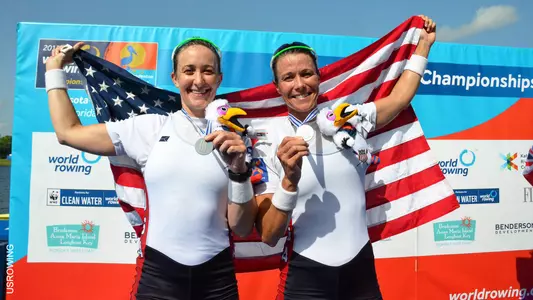
Your teammate Meghan O'Leary also won the Female Athlete Year Fan Vote after the two of you earned the highest double sculls finish ever by an American boat. How happy were you for her, and what was it like to earn that silver medal at the World Championships last summer in Florida?
For the fan's choice award, you have to send in nominations and Meghan received several nominations before she went on the ballot. I was one of the people who nominated her, because without her I would not be where I am. I would probably not have kept rowing after not making the (2012) Olympic team without her being there to pursue this goal with. She is an incredible athlete and was also chairing the board of directors at one point this year for U.S. Rowing. She has been so involved and she does so much for the sport, and I felt like she really deserves just as much recognition as me. We share everything in the boat, and I felt like it would be awesome to share my award with her as well. She is very deserving of the fan's choice. She's also pretty active on social media, so she has a pretty significant following among rowing fans.
People recognizing what we did (at the World Championships) as being special or extraordinary means a lot. The women's double is a very tough field and it's very competitive internationally. This is something that I've had a goal to do, medal at the World Championships or Olympics, since 2008. Crossing the finish line in Beijing in fifth place, I was like 'I'm going to keep going. I'm going to come back for more. I want to medal this time.'
To finally have one step of that goal fulfilled and realized was pretty awesome. I feel like our hard work is finally starting to pay off.
How much does your knowledge of the history of the event, and knowing that the U.S. had never finished higher than third, weigh on your mind in a race like that? Were you focused on changing that trend, or is it something that just came as a byproduct of hard work?
I knew that the U.S. had never won the event at a World Championship or the Olympics, and I knew what the highest finish was, a bronze medal, but for me it was more about just getting a medal and, more importantly, having our best performance at that regatta. We always felt like we've let something get in the way of our performances at past World Championships. There was always something to overcome and maybe we didn't do the best job doing that, especially on that final day when it came down to winning a medal. This regatta was all about showing up and executing to the best of our abilities. Both of us believed that if we did that, we would medal, but to have that actually come true was pretty special because what you feel and what you think is not always reality. To have it actually become reality was really great.
In a sport where injuries and nagging injuries are common, can you share any wisdom with younger athletes who may get down mentally when working back from an injury? Did overcoming the injury you battled through this past season make your accolades from this season any more special?
Yeah, definitely. Throughout my career I've had a lot of injuries, and as you mentioned, this year was no different. I had an injury that kept me off the water from January until June, and it was really, really, really difficult. There were a lot of days when I did not want to show up or sit on the bike because it's so boring. I wanted to be out on the water and rowing and racing and having fun and actually doing the sport that I was trying to make the World Championship team for. It can be really tough. I watched a lot of Netflix, listened to a lot of music and podcasts, and I did a lot of visualization; thinking about our Rio final and not getting the result that we wanted in 2016. I was thinking about what I needed to do to make that change and get the result we wanted. Especially on days where I did not want to be there, that was what I was thinking about. I was also thinking, 'What are my competitors doing right now?' This is rowing, everyone gets injuries. I'm sure the stroke seat of the New Zealand double is on the bike right now, too, or was at some point of the year. She worked her butt off and I have to, too, if that's who I want to beat. That's really important to fall back on. Remembering (your goals) and making it really clear what those goals are is also really important. Holding yourself accountable so that, on the days when you don't want to get out of bed and do your PT exercises, it helps you remember what you are doing them for so you are not just going through the motions. That makes a big difference.
 Ellen Tomek said that playing more than one sport before she started rowing has helped her being a more well-rounded athlete and that has been key to her maintaining her fitness level away from the boat.
Being a trial boat, we actually train a little bit outside of the group, but I do have a couple of teammates who I am close with. Being able to bounce my feelings off of them and talk to them about the struggles I was having that, more than likely, they had gone through something similar to was important. They were able to know what I was feeling and share my experiences and thoughts and tell them my doubts about the process. Turning to them for advice and just to have an ear to listen to me; I felt like that was really helpful, especially just having a few close people who get you and can help you get back on track.
Have you seen photos or video of the new South Campus Performance Center? If so, what are your impressions, and what can a facility like that do for a young athlete breaking into the sport?
Yes, I have seen the video and oh my gosh. It is incredible. I think the first thing I said was 'Can I go back and be recruited? I want to go row for Michigan!' Nowhere else in the country has a facility like that. The resources that the team has at its disposal and that incoming recruits will have at their disposal are absolutely incredible. Having tanks as a novice or first- or second-year rower and to get that rowing stroke in year-round is going to make such a difference and will help in competing against schools that can be in the water year-round. Having facilities that make you excited to be there and excited to show up to practice brings that added energy; it can help boost the team and make them faster. Watching the video, some of the girls were tearing up and having that to go to every day for practice is incredible.
When I was an athlete, there was talk of the tanks or building the tanks. We'd talk about ways to donate to the tanks and we'd always talk about how we needed indoor rowing facilities. To have that facility finally realized is incredible, and it's special for me because I'm still so involved in the sport. Some of the other athletes I rowed with at Michigan, they most likely have other things more important to them than rowing in their lives. But for me, I'm so involved in the sport and know how important that is for them -- I'm jealous of those facilities. Being on the national team, I'm at the top level in the country and I don't have access to that. I'm jealous they get to train there every day.
You were a multi-sport athlete growing up. What did that mean for you in your athletic development and is that something you would encourage parents of younger athletes to do?
Yes, I played basketball and softball in high school and didn't start rowing until my freshman year at Michigan when I tried out for the novice team. I think for me, I learned a lot about hard work and discipline and dedication and teamwork, especially playing basketball. We were two-time state champions when I was there. I did not get to play much so that was not all me at all; that was my teammates. But being a part of that and seeing how a great team worked together and how a successful team functions, that really gave me a good base coming into Michigan and coming into the sport of rowing; how to work hard and how to work hard and well with others. Learning about that hard work and dedication from my teammates and coaches definitely helped me with rowing. I don't want to toot my own horn, but a lot of rowers are good at rowing but maybe not (have) as many other athletic skills. What has helped me was, because I have had so many injuries in the past, being able to turn to my other athletic backgrounds and still train hard. I don't do all my training just rowing. I'm on the bike, I swim, I run and I'm able to maintain my fitness level that way.
I would encourage people to be really well-rounded. Pick a sport you love and are excited by and find your thing. I love rowing. I think everyone should row or at least try it at some point in their life, but I think knowing that a sport is for you is important and I think high school is a really good time to participate in a lot of different sports.
Our program has a diverse group of alumnae who have accomplished things in many different professional fields. Are you able to see some of what any other alums are doing or stay in touch with them?
Sarah Trowbridge, who was a year ahead of me and was on the team, is actually my rowing coach. We asked her to come on and help coach us for the Olympic year and we're going to continue working with her. I'm very close with her and talk to her a lot, but obviously that's within the rowing world.
One of my closest friends from the team, Hillary Van Duyne Shemes, who was a year older than me, is a doctor and has a practice in Michigan. When I go home or go to see her, I make sure to stop by and say hello and meet her kids and talk about her family and career. She was always someone who was so dedicated to the team and was really a great friend on the rowing team who is now very far outside of rowing, but I keep in touch with her because we had such a great connection and she is a very good person. She's someone I like to keep in touch with and hear how she's doing.
How often do the fundamentals you learned under Coach Rothstein and his class resurface in the training you do today?
It's my entire foundation of rowing. It's funny that we did this today, because I'm still in contact with Emily Ford, who was the associate head coach when I was at Michigan. She's now with the University of Virginia, but I just had lunch with her and we were talking Michigan rowing and catching up a little bit. She, along with Mark and the rest of the staff there, they taught me how to row. They taught me what pulling hard on a 2K meant; they taught me how to move with the speed of the boat. Thinking about them ... everything comes back.
To have that foundation from them is really great. They taught me what I know about rowing and I tell them that they helped me learn to really love the sport and learn to appreciate the sport. I'll always appreciate having gotten my start there.
Thank you for the time, Ellen. We hope to see you at our new facility soon!
I can't wait to see the new facility and I would love to get a few workouts in there!