10/29/2026 10:00:00 AM | Football
Continuing the series that began in 2016-17, each week MGoBlue.com will highlight a Michigan student-athlete and their academic pursuits. These are our Scholar-Athlete Stories.
By Gerardo Tinajero
Growing up, Evan Link's older brother had an unusual way of testing their homemade inventions: he sent his younger brother down a hill in them.
Armed with whatever materials they could find in the family garage, the two spent summers building contraptions, experimenting with new ideas and discovering what they could create with their hands. As the younger sibling, Link occasionally found himself serving as the test pilot.
"It was really just seeing whatever I had in my garage and just trying to make some fun out of it," Link said.
Those childhood adventures eventually expanded into metalworking projects with a neighbor, giving Link new opportunities to explore his curiosity about how things were made.
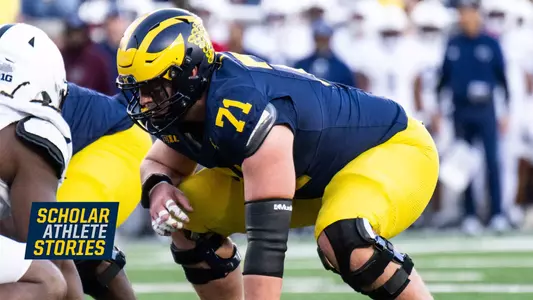
Years later, that same curiosity has found a home at the University of Michigan, where Link is pursuing a degree in mechanical engineering while competing as a member of the football program.
What began as a childhood pastime has developed into an ambition shaped by curiosity, discipline and a desire to use his education to make a difference.
Born in Seattle, Link grew up moving around the country with his military family before spending much of his youth in the Washington, D.C., suburbs. Through the constant relocation, education remained a priority.
His parents emphasized academic achievement and instilled habits that continue to guide him today. Completing schoolwork before enjoying free time was an expectation growing up, one that Link eventually adopted as his own.
Football, meanwhile, developed into an unexpected opportunity. Although he began playing at a young age, Link did not seriously consider pursuing the sport at a higher level until high school.
As his athletic opportunities expanded, he approached football with the same ambition he brought to the classroom.
"If I can do this, I can do this football thing on a high level; why not try and do that as best I can?" Link said.
When college recruiting began, he wanted to attend a university that would allow him to pursue both interests. Michigan stood out due to its football tradition and engineering program.
Having grown up watching Big Ten football, Link was familiar with Michigan's history. Equally important was the opportunity to pursue a degree in a field that had fascinated him since childhood.
"I grew up watching Big Ten football, and so I always knew Michigan," Link said. "Michigan football was synonymous in my mind with long-term success, history and legacy."
For Link, that sense of legacy extended beyond athletics. Becoming a Michigan engineer meant joining another community whose members had gone on to create and contribute in meaningful ways.
That vision began taking shape during the second semester of his freshman year.
In an introductory engineering course, Link helped build a small underwater remote-operated vehicle. The project brought him back to the afternoons he spent experimenting in his garage, but this time he was applying those interests in an academic setting.
"It was what I always wanted to do growing up," Link said.
The experience reinforced his decision to pursue mechanical engineering. He was no longer simply imagining what he might build. He was learning the principles behind those creations and putting them into practice.
His enthusiasm continued into a sophomore-year design course, where he worked in a machine shop using tools and materials to manufacture components. For someone who grew up building things by hand, the opportunity to work with metals offered a new dimension to an old passion.
However, Link's education at Michigan has also changed his approach to finding solutions.
During his freshman year, Math 215, a multivariable calculus course, introduced a different level of problem-solving than he had previously experienced. Mathematics had long been one of his stronger subjects, but the course taught him to become more comfortable with questions that did not have immediate answers.
Over time, his perspective shifted. Rather than seeing a difficult problem as a reflection of his ability, he learned to appreciate the process of working toward a solution.
"It's supposed to challenge you; it's supposed to make you think and sit for a while and then sit with it and figure it out," Link said.

That lesson carried into other engineering courses, including ME 382, taught by Professor Joe Estrada. Link appreciated his teaching style and continued developing the patience needed to approach unfamiliar material.
He also began recognizing how closely that mindset aligned with the habits he was developing in football.
When Link first arrived at Michigan, he paid close attention to the veteran offensive linemen around him, observing how they approached patience, preparation and daily responsibilities.
Their example helped him understand what it meant to improve through consistent effort, a lesson he began applying to his academic work.
One of the routines Link developed was remaining at the football facility after practice to complete assignments before heading home.
The familiar environment helps him maintain the focused approach he brings to his athletic responsibilities, allowing him to transition into coursework with the same sense of purpose.
"Here's where you go to work," Link said of the facility.
Along the way, Link has learned that developing those habits does not mean doing everything alone.
During his freshman year, two older teammates studying engineering offered encouragement as he adjusted to his coursework. Their reassurance helped him recognize that his experience was not unique and that he would continue finding his footing.
Link also credits Michigan's coaches and academic support staff for providing guidance throughout his college career. As he has become more independent, he has appreciated knowing those resources remain available whenever he needs support.
Beyond those relationships, Link has found another meaningful part of his Michigan experience through friendships on North Campus.
While football has given him a close-knit community of teammates, engineering has introduced him to students with different interests, experiences and perspectives.
For Link, having those distinct communities has been particularly valuable.
"I get to learn from other people who do different things but also are in the exact same challenging courses as I am," he said.
Those connections have broadened his perspective and reinforced the value of learning from people whose experiences differ from his own.
As Link considers what he wants to accomplish beyond college, he is increasingly interested in how engineers can use their work to make a positive impact on others.
Through his engineering education, he has developed an appreciation for people-centered design, an approach that considers not only whether a product works but also whom it serves and how it affects the world around it.
"How can I make not just this machine work, but how can I make this machine work for people?" Link said.
That perspective reflects a value he has carried since childhood: the importance of doing things for others.
As he looks toward the future, Link is eager to explore the engineering industry, discover new technologies and find meaningful problems to solve. Although he remains open to wherever football may take him, he is equally excited about the opportunities awaiting him as an engineer. For younger student-athletes hoping to pursue ambitious goals in both areas, Link offers a message shaped by his experience.
"The biggest thing is you can do both," he said. "You can be a great athlete; you can also work really hard in the classroom and achieve something there as well."
As Link moves closer to earning his Michigan degree, he hopes to look back knowing he gave his best effort to both pursuits.
But his ambitions extend beyond individual accomplishments.
The boy who once experimented with homemade inventions in his family's garage is now preparing to apply that same curiosity to challenges beyond the classroom.
And while Link does not yet know exactly what he will build next, he knows what he wants that work to mean.
"I want it to be something that makes people's lives better, helps somebody in some way," Link said.
For Link, the goal is not simply to build something that works. It is to build something that matters.