Kornacki: The Tale of Al Renfrew & Wally Grant
12/11/2014 12:00:00 AM | Ice Hockey
Dec. 11, 2014

By Steve Kornacki
ANN ARBOR, Mich. -- They met as teenagers fresh out of high school, eager to make a mark in college ice hockey at the University of Michigan.
World War II had just ended in 1945, when Al Renfrew arrived from Toronto and Wally Grant from Eveleth, Minnesota. And in 1948, they reached the mountaintop together, winning the very first NCAA hockey championship under legendary coach Vic Heyliger.
That's usually where the story ends for great student-athletes, who generally go their separate ways upon graduating and completing their athletic eligibility. But the tale of Al & Wally was only beginning. They remained at the core of the Wolverines' hockey program -- which now boasts an NCAA-record nine championships and 24 Frozen Four appearances -- for 70 years. Renfrew became the coach and won a national championship, while Grant became the heart and soul of the program's Dekers Blue Line Club and endowed the program's first scholarship along with his wife, Mickey.
If you saw one, odds were you saw the other. But then Grant died on Nov. 5 after battling Alzheimer's, and on Nov. 10 Renfrew's big heart finally gave out. Grant was 86 and Renfrew was 89.
And so, after coming in as a duo, they left as one, too. Renfrew, who later served as Michigan's long-time ticket manager and was the originator of the M Club banner that football players jump to slap before home games, was gone less than one week after calling Mickey with his heartfelt condolences.
Their "good old days" spanned eight different decades, and Michigan hockey won't be quite the same without them.
"Al and Wally were the two I had the most ongoing contact with," said Paul Milanowski, 86, a backup goalie on the '48 champions who now lives in Michigan's Upper Peninsula. "And now we've lost them both."
Milanowski's voice trailed off for a few seconds.
Then he added, "They were very special to me. Al was so kind and friendly, and Wally was a very nice guy. I was the only one without a scholarship, and so I didn't have as much off-rink contact with my teammates. But they both were particularly nice to me."
Al & Wally went out of their way to make sure Milanowski was included in everything. He recalled Al getting together with him and a few other players "to have a pop and talk" after winning the '48 title in Colorado Springs, Colorado.

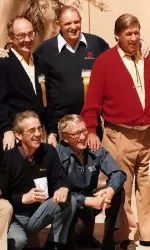
Grant (left) and Renfrew at a 1985 team reunion and with former teammates and family (from left): Wally Grant, Louie Paolotto, Marge Renfrew, Mickey Grant, Earl Keyes, Deloris Paolotto, Al Renfrew.
"Al was the glue who kept the guys together," said Mickey Grant. "Al and (wife) Marge and Wally and I went on trips with the team when Red (Berenson) became the coach. And for a while, I worked with Al at the ticket department. I'm really going to miss Al. He always made me laugh even though his jokes were corny."
She chuckled at the thought of his endless stream of one-liners. Once, when Renfrew was asked for advice by somebody ready to take a chance, he replied: "Why not! Columbus took a chance."
"We were all really good friends," said Mickey, who recalled their favorite hangout in Ann Arbor, the Town Club, which is long gone from the corner of Liberty and Ashley. "He called the day after Wally went, and Al's gone now, too. That's hard to think about.
"I have a picture of the '48 team that I am looking at, and so many of them are gone."
Judy Hart called her father, Al, to inform him of Wally's passing.
"He called Mickey right away," said Hart. "Both of them cared so much for each other and had so much respect for each other. They had a great friendship -- they were real buddies."
She recalled how they used to attend Berenson's radio show taping at a local establishment.
"They would set me up with the answer to the trivia questions on the show," said Hart. "I'd get it right, and the announcer would say, 'Oh, no, not you again.'"
She laughed again at the thought of it.
"Wally was the master of ceremonies at Dad's retirement party," Hart added. "My parents and the Grants -- the four of them were so close."
Mickey said, "We watched Al's kids and grandkids grow up."
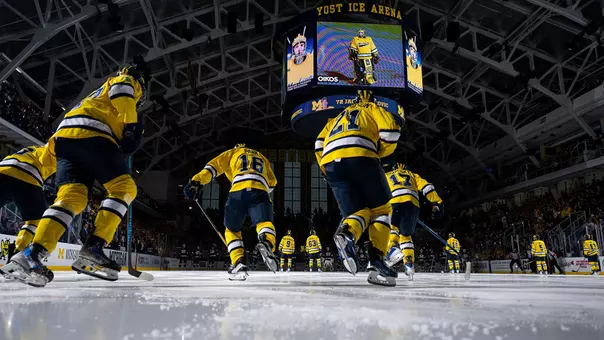
Mickey still goes to the games at Yost Ice Arena, which was a basketball facility when her husband and Renfrew played hockey. And the Michigan hockey family will surround her with warmth and support in those second-level seats above the Wolverine bench that the four of them occupied for years. Al's familiar laugh and her husband's knowing glance are gone, except in her memory, and that will remain a comfort.
She will look down on the ice at freshman center Dylan Larkin, who has the scholarship she and Wally endowed, and their impact will continue skating up and down the rink on State Street for years to come.
Hockey was family for the Grants and Renfrews, and they began a line of greatness.

Wally Grant (front, second from left) and Al Renfrew (back, second from right, next to Vic Heyliger) in 1985 at a team reunion. Back Row (from left): Ron Martinson, Bob Heathcott, Paul Pelow, Lou Paolotto, Earl Keyes, Renfrew, Heyliger. Front Row: Ross Smith, Grant, Connie Hill, Dick Starrak.
A look at the careers of two Michigan hockey legends:
AL RENFREW

Renfrew ended his college career as the second-highest scorer in school history with 91 goals, 81 assists and 172 points, and he won a national championship in 1948 before serving as captain in 1949. The speedy left-winger became Michigan Tech's head coach and lost the 1956 NCAA championship game to Michigan and his mentor and brother-in-law, Heyliger.
Renfrew replaced Heyliger the next season and recruited Berenson before leading the Wolverines to the 1964 national championship, which he once called "the biggest thrill in my life." He went 222-207-11 with five conference championships in 16 seasons and remains the only man to win a national title as both a player and head coach at Michigan. Renfrew was inducted into the Michigan Hall of Honor in 1986.
"Al was one of the main reasons I came back as a coach," said Berenson. "I appreciated a coach who cared about his players, cared about them going to school, cared about their future. And we became life-long friends. It wasn't like he was your coach and then he was gone. It was like he was part of your family.
"He touched so many different eras. He played in his era, and was a noted player and a captain, and played on a national championship team. And then he became the coach of the program and had his own national championship team. And his former players and their families would come to the tailgate party at his house before and after the football games. So, it was a never-ending legacy. It wasn't like he came and had a shining moment and left. He never left. He was always here."
Renfrew's teammate, Milanowski, said, "Al had speed and a real drive. He was an aggressive forward and a good playmaker -- and a good, cheerful spirit who inspired me."
Jim Keough both played and coached for Renfrew.
"What made Al special to all of us was the fatherly side," said Keough. "You always knew what Al stood for, and Marge was like a mother to the whole team. And Al was a laugh a minute -- the king of the one-liners."
The Renfrews raised three children on White Street, one block from Yost, in the house Heyliger once lived in.
"Dad met Mom when she was babysitting Uncle Vic's twins," said his daughter, Hart. "Mom's sister was Vic's wife. They met there at Dad's coach's house, and the rest is hockey history. It's a small world."
WALLY GRANT

Grant was Michigan's first three-time All-American. The tenacious left winger, at 5-foot-8 and 165 pounds, was speedy and tough. He played on the formidable "G-Line" along with center Wally Gacek and right wing Ted Greer, and Grant scored the game-winning goal of the 1948 national championship game against Dartmouth at 1:30 of the third period, opening the floodgates for an 8-4 victory. He had two goals and three assists in that game.
"Wally was very fast and a very capable stick-handler," said Milanowski. "He had great shooting skills and was the fastest player on the team."
Grant, who scored 63 goals and had 83 assists for 146 points for the Wolverines, is a member of both the United States Hockey Hall of Fame and Michigan Hall of Honor. He graduated from Michigan's business school and worked for General Motors, while serving as president of his alma mater's Dekers Club.
"He was a terrific player and yet he was so humble," said Berenson. "You had to coax him to get him to talk about himself. He was one of those people that it was always about somebody else -- it wasn't about him. He was friendly and had opinions about things. He was very observant. He cared about hockey; he cared about everything. He was of great value to his family. I just remember his friendliness and his caring about our program as if he was coaching it. And never intruding but always supportive -- like, 'What can I do to help?'
"And he and Mickey were just terrific. His teammates knew him as a three-time All-American, a tremendous player and a great guy. Now, our players know him as an older guy who was always around and friendly and had a scholarship named after him. And those of us who knew him better than that realized that he did more for this program than anybody. He played, and he supported. And it wasn't just about money -- it was about being around and being interested."
Mickey said, "Wally was just proud to be able to play at Michigan and to win the first NCAA championship. That was real important to him.
"He only looked to the day he was living, but I wonder what it would've been like had he signed with the (Detroit) Red Wings (while still at Michigan). But he still had another year of school and his dad said, 'Finish your education.' And he did, but he never got another chance to sign with the Red Wings.
"But he had a real dedication to hockey and Michigan, and Vic said he was the best two-way player he ever saw."