Michigan Monday: Game 12 at Ohio State
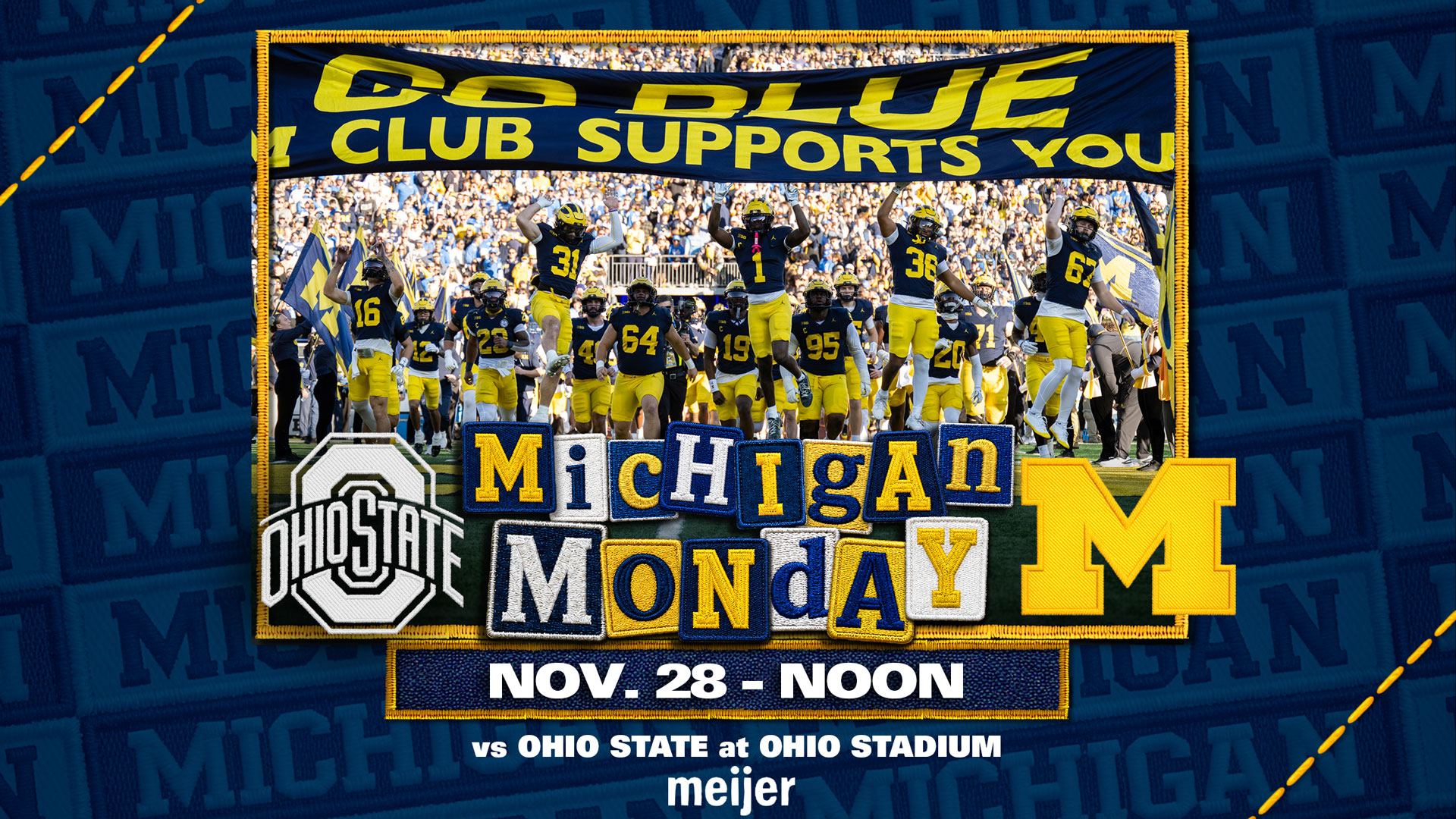
Date Saturday, Nov. 28
Kickoff Noon ET
Location Ohio Stadium
Television Fox
What You Need to Know
- This will be the 122nd meeting between Michigan and No. 25 Ohio State.
- The Wolverines have won four of the last five games and hold a 62-53-6 lead in the all-time series.
- The team that has won the rushing battle in this game has won the contest in 24 consecutive matchups (2001-present).
- U-M's defense has yielded 16 touchdowns and ranks 17th overall in scoring defense (17.5 ppg).
- Savion Hiter leads the team in rushing with 542 yards on 132 carries with four TDs.
- Chris Bracy is leading the secondary with two interceptions, three sacks, four TFLs and 80 total tackles.
Game Resources
Gameday Information
Location
Ohio Stadium -- Columbus, Ohio
Weekly Notes
Explore this week's Michigan Football notes by category.
Michigan vs. Ohio State
- This will be the 122nd meeting between Michigan and Ohio State.
- The Buckeyes are the most common opponent for the Wolverines, followed closely by Michigan State (119 games).
- The Wolverines hold a 62-53-6 advantage in the all-time series, but the Buckeyes have a 6-4 edge in the last 10 meetings.
- Michigan has won four of the last five matchups, defeating Ohio State at home in 2021 and 2023 and in Columbus in 2022 and 2024; U-M lost last season's game in Ann Arbor.
- This will be head coach Kyle Whittingham's second meeting with Ohio State; his team lost 48-45 to the Buckeyes in the 2022 Rose Bowl Game.
Michigan vs. Ohio State in Columbus
- The Wolverines have a 29-28-2 record all-time in Columbus, including a 26-24-1 mark at Ohio Stadium.
- U-M has won its last two meetings at Ohio Stadium, ending a nine-game losing streak at the venue with a 45-23 victory in 2022 and following with a 13-10 win in 2024.
- Prior to 2022 and 2024, the last win by the Wolverines at Ohio Stadium came during the 2000 season, a 38-26 victory that captured the Big Ten championship.
The Game
- The Game was selected as the greatest rivalry in all of sports by ESPN.com in 1999.
- The Game ranks tied for 14th among the most-played rivalries in FBS (Division I-A) history.
- The two programs played every year from 1918 through 2019 (102 years), a streak that ranked eighth in Division I-A for the longest uninterrupted series; the 2020 game was canceled due to COVID-19 issues within the Michigan program.
- The overall series dates back to 1897, when the Wolverines claimed a 34-0 victory over the Buckeyes in Ann Arbor.
- The Game was moved to the final Saturday of the Big Ten season in 1935; since that time, the matchup has had the potential for a major impact on the Big Ten standings 51 times.
- There have been 24 occasions when the two schools decided the Big Ten champion between themselves based on the outcome of that Saturday's game; for 10 years (1972-81), the outcome decided which team would represent the Big Ten in the Rose Bowl.
- Since the Ohio Stadium dedication game in 1922, more than 9 million fans have attended the annual game between the two schools, with 75 of those 103 games being sellouts.
- Since 1922, more people have attended this game than any other gridiron matchup in the country.
- The team that has won the rushing battle in this game has won the contest in 24 consecutive matchups (2001-present; 2020 not contested).
- The Game will be televised for the 59th consecutive year and 70th time overall.
- Since 1967, every game in the series has been televised, including 39 national television appearances; the 2020 game was scheduled to air on Fox but was canceled due to COVID-19 issues within the Michigan program.
- This is the ninth straight season that Fox will broadcast college football's top rivalry game.
- ABC televised the rivalry for 30 consecutive years (1987-2016), with all but the 1995 game being a national television broadcast; the 2005 game was a split national broadcast on ABC and ESPN.
- The first game televised between the two programs was Michigan's 21-0 victory in Ann Arbor in 1947.
Team
- The Wolverines will play their fourth and final Big Ten road matchup this weekend at Ohio State. U-M is 1-2 away from Ann Arbor so far this season and 19-7 as the visitor in league games since the start of 2021.
- According to ESPN Stats and Info, the win over No. 4 UCLA was Michigan's fourth (4-1) against teams 10-0 or better in the past five years. All other FBS teams have a combined 10 wins in that same time span.
- The win was Michigan’s ninth since 2000 to come when the Wolverines are unranked and facing a ranked opponent: 2005 at No. 11 Michigan State; 2007 vs. No. 10 Penn State, vs. No. 9 Florida (Capital One Bowl); 2008 vs. No. 9 Wisconsin; 2009 vs. No. 18 Notre Dame; 2015 vs. No. 22 BYU; 2024 at No. 2 Ohio State, vs. No. 11 Alabama (ReliaQuest Bowl).
- Since the start of the AP Poll in 1936, U-M has been unranked facing a top-10 opponent on 39 occasions. U-M has a record of 14-25 in those games, with wins in 1939 (No. 6 Ohio State), 1944 (No. 10 Purdue), 1950 (at No. 8 Ohio State), 1954 (No. 4 Iowa, No. 8 Minnesota), 1962 (No. 10 Army), 1963 (at No. 2 Illinois), 1993 (No. 5 Ohio State), 2005 (No. 8 Penn State), 2007 (No. 10 Penn State, No. 9 Florida [Capital One Bowl]), 2008 (No. 9 Wisconsin), 2024 (at No. 2 Ohio State) and 2026 (No. 4 UCLA). Ten (10) of the 14 wins have come at home, where U-M is 10-17 in such contests.
- U-M has played in overtime twice this season, sporting a 1-1 record with last weekend's win and a loss to Indiana earlier in the year. U-M's most recent season prior to this one with multiple overtime decisions was the 2013 season, when U-M lost at Penn State in four overtimes and won at Northwestern in three. There has never been a Michigan football season that featured three overtime games.
- Across 121 meetings with Ohio State, Michigan sports a 62-53-6 all-time record. OSU won in Ann Arbor last season, snapping a four-game winning streak for the Maize and Blue that tied the program's third-longest in series history (1988-91; longer streaks from 1922-27, 1901-09).
- The Wolverines are 29-28-2 all-time in games played in Columbus, including a 26-24-1 all-time record at Ohio Stadium.
- In 50 of 89 meetings since the advent of the AP Poll in 1936, both teams have been ranked, including each of the most recent six meetings (U-M 4-2 from 2021-2025).
- For this edition of The Game, neither team is ranked, marking just the 10th time in series history, and the first since 1987 (1951, '53, 1959, 1962-63, 1965-'67, 1987). The Wolverines faced a top-10-ranked Ohio State team for 13 straight meetings from 2012-25 (2020 not contested).
- The team that has won the rushing battle in this game has won the contest in 24 consecutive matchups (2001-present; 2020 not contested).
- Fifteen (15) Wolverines have made their first collegiate starts this season: tight end Jalen Hoffman, linebackers Troy Bowles and Chase Taylor and defensive end Dom Nichols against Western Michigan; tight end Eli Owens against Oklahoma; cornerback Shamari Earls and wide receiver Salesi Moa against UTEP; offensive lineman Avery Gach (rhino) against Iowa; offensive lineman Manuel Beigel (rhino) against Penn State; quarterback Tommy Carr, defensive end Benny Patterson III, right tackle Marky Walbridge against Indiana; defensive end Tariq Boney at Rutgers; wide receiver Travis Johnson against Michigan State; running back Savion Hiter against UCLA.
Offense
- U-M has at least one scoring drive of 10-plus plays in eight of 11 games this year. The offense also has at least one scoring drive of six plays or fewer in 10 games. Last weekend, U-M scored on a five-play drive capped by Mason Bonner's first career score.
- A balanced stable of contributors has scored for the maize and blue so far, with nine different touchdown scorers (five players with rushing touchdowns, four receiving). Three of those are freshmen (Mason Bonner, Savion Hiter, Salesi Moa).
- The Wolverines continue to work towards improvement in their third-down conversion rate, now at 40 percent (58-of-145). The offense has been better on fourth down, with a 50 percent conversion rate (8-of-16).
- Michigan's offense has been generating explosive plays (20-plus yards) more consistently in the run game. The offense has generated 26 explosives, including 19 via the passing game, but runs have made up four of the five most recent offensive explosives.
- JJ Buchanan (nine) and Andrew Marsh (four) continue to lead the team in explosive offensive plays, all receptions. Hiter (three) has the most explosive rushes. Marsh led U-M in 2025 with 15 explosive plays on offense (14 receiving, one rushing), and another eight via special teams returns.
- Jordan Marshall (five touchdowns) has found the end zone most often on the ground, and Buchanan (five touchdowns) is the leading scorer through the air.
- Marsh reached 1,000 career receiving yards during the 2026 season; he has 1,110 for his career across 22 career games (459 this year).
- The duo has combined for four 100-yard games this season in Buchanan (126 vs. WMU, 130 vs. Iowa) and Marsh (105 vs. UTEP, 106 vs. Iowa).
- Of the team's 11 pass-catchers so far this year, four are freshmen (Mason Bonner, Savion Hiter, Travis Johnson, Salesi Moa). Bonner (27 yards, 26 yards), Moa (44) and Johnson (21) have registered explosive plays in recent weeks.
- Marshall is also closing in on a career milestone, with 1,404 career rushing yards. With 96 more, he'll reach 1,500 for his career.
- Running back Savion Hiter’s 70-yard touchdown run at Oregon marked the longest touchdown run by a freshman back since Tyrone Wheatley’s 74-yard touchdown against Northwestern in 1991. It is the third-longest run by a Big Ten back this year in league play.
- Hiter’s touchdown was U-M’s longest offensive play this year and a career-long rush for the first-year back, who scored the fourth touchdown of his freshman season (all rushing).
- Hiter has carried the load in recent weeks and has consecutive 100-yard performances. He parlayed 13 carries into 107 yards and turned 26 carries into 104 yards in Saturday's effort.
- Hiter's 26 carries against UCLA are tied for the second-most by any Big Ten back in a league game this year (Kamari Moulton; Iowa vs. Washington, L.J. Phillips Jr.; Iowa at Illinois). Only Fame Ijeboi (Purdue vs. Minnesota, 31 carries) has seen a bigger rushing workload in a conference game.
- Hiter is the first U-M freshman running back with multiple 100-yard efforts in a season since 2019 (Zach Charbonnet; Army, at Illinois).
- The long play at Oregon helped lead to U-M's best rushing output on the season (215 yards) and the second game this season with 200-plus rushing yards (Penn State, 211).
- The offensive line continues to grow as a unit; six players have now made double-digit starts at Michigan: left guard/tackle Evan Link (28 starts, 27 at tackle), center Jake Guarnera (21 consecutive; 10 at guard), tackle Blake Frazier (16, including six at right tackle), right tackle Andrew Sprague (15) and guards Nathan Efobi (14) and Brady Norton (11). Manuel Beigel (two starts) and Marky Walbridge (three) have also been late-season regulars.
- The line permits an average of 5.36 negative plays per game, ranking 72nd nationally in TFLs allowed, and has employed six different starting lineup combinations across 11 games.
- First-year quarterback Tommy Carr made his first career start against Indiana. He is the sixth first-year signal caller to start for U-M, joining teammate Bryce Underwood (2025), Tate Forcier (2009), Chad Henne (2004), Rich Hewlett (1979) and Rick Leach (1975). Carr and Leach are the only two among those six who did not start the season opener.
- Carr went 22-of-27 passing at Rutgers in his first career win as a starter, marking the highest single-game completion rate (81.5 percent) for a freshman starting quarterback in U-M history (minimum 20 attempts).
- Carr and Underwood split time at Oregon. Carr started the game before Underwood entered after two drives and played the remainder of the first half. Carr returned to start the third quarter before Underwood re-entered in the fourth quarter.
- Underwood regained command of the starting role against UCLA. It marked the 20th start of Underwood’s career and his seventh this season (first since Penn State, Oct. 17). The team has a 14-5 record behind Underwood.
- Underwood spread the ball to six different pass-catchers in regulation, then found tight end Jalen Hoffman on the game-winning two-point conversion play in overtime for the senior's first career points.
Special Teams
- Punter Cam Brown averaged 43.9 yards on 22 punts during his freshman season at UNLV and has averaged 42 yards per punt so far this season. U-M ranks top-15 in punt return defense (2.67 yards per return allowed, 12th nationally), in part due to Brown's hangtime and consistency.
- Brown has punted 51 times this season, with 24 punts inside the 20-yard line and 11 punts inside the 10-yard line. He has been a weapon and stymied opposing return units, with 24 fair catches forced and three punts downed at the one-yard line.
- Against Oklahoma, he pinned the Sooners inside their 20 on six of seven attempts; at Oregon, Brown allowed minus-six return yards on five punts; against UCLA, he allowed two return yards on five punts with three at the 12-yard line or deeper.
- Kicker Jacob Baggett has generated 25 touchbacks on 39 kickoffs (64.1 percent).
- Against UCLA, Baggett enjoyed his best scoring performance to date. He converted three field goal tries (46 yards, 29, 52), converting a career-long to put U-M up 16-13 in overtime. It was the longest conversion by a U-M specialist this year.
- Freshman Salesi Moa had his first game as punt returner for U-M against Penn State. He recorded two returns for 25 yards against Indiana before busting the longest return of his young career, a 23-yarder, against UCLA. It was the longest punt return by a Wolverine since the 2023 season, when Semaj Morgan had an 87-yard return touchdown against Iowa in the Big Ten Championship Game.
Defense
- The defense is ranked ninth nationally in total defense, allowing 278.3 yards of total offense per game to opponents. Oregon (467 yards) and Penn State (332 yards) are the only teams to reach 290-plus yards of total offense against the Wolverines.
- The defense excels in all situations. U-M has allowed the 10th-fewest first downs (170, 15.45 per game) in the nation and ranks 40th nationally in third-down conversion rate allowed (35 percent).
- Through 11 games, the U-M defense has yielded 16 touchdowns and ranks 17th overall in scoring defense (17.5 points per game allowed). Oregon (21, first half) is the only team to score more than 14 points in a half against U-M this year.
- UCLA (126 yards, three points) was limited to its least-productive first half of the season in terms of yardage and points.
- That scoring defense has been consistent; seven opponents have been held to 18 points or fewer, and only Oregon (31) has exceeded 21 points.
- The rush defense has kept opponents below 100 yards on three occasions (under 110 yards six times), allowing 103.5 yards per contest, on average (18th nationally). No team has exceeded 132 yards on the ground (Western Michigan), which required 46 rush attempts to reach that number.
- U-M has allowed the fifth-fewest runs of 10-plus yards against them this year (24 in 11 games). Only Iowa (16), Notre Dame and Miami (21 each) and Wisconsin (23) have allowed fewer.
- Linebacker Troy Bowles leads the defense in tackles (88), eight clear of the next-closest defender. Chris Bracy (80) leads the secondary and John Henry Daley leads the defensive linemen (37). Bowles is fifth in the Big Ten in total stops and Bracy is sixth in the league in solo tackles.
- Twelve (12) different players combined for 11 tackles for loss against UTEP, the most by a U-M defense in a single game since 2022 (11 against Colorado State, Sept. 3). Nineteen (19) different players have at least a share of a TFL through 11 games.
- John Henry Daley leads the defense with 11.0 TFL (24th nationally; third, Big Ten). Daley is also the team's leader in sacks, with 8.0 (14th nationally; fourth, Big Ten). Twelve (12) different players have at least a share of a sack so far this season.
- The defense ranks 17th in passing yards per game allowed (174.8). Opposing passers have thrown 13 touchdowns to eight interceptions.
- With his first-quarter breakup against the Spartans, Zeke Berry reached 27 career pass breakups, tying him with Jeremy LeSueur (2000-03, 27) for eighth-most all-time at Michigan. James Whitley (1997-2000, 28) and Lavert Hill (2016-19, 29) are next up on the top-10 list.
- The defense has forced 12 turnovers through 11 games, including eight interceptions, two of which have been returned for touchdowns. Three interceptions have been returned 24 yards or more. U-M has generated 152 return yards on its interceptions this year compared to 17 total return yards on nine picks for opponents.
- Those two defensive touchdowns make U-M one of 19 teams in the nation with multiple scores from the defense.
- Jonah Lea'ea recorded the shortest pick-six in program history when he returned an interception nine yards for the score against UTEP to end the nonconference slate. At Minnesota, Nathaniel Staehling recorded the longest pick-six on the road in program history when he returned an interception 79 yards for a touchdown.
- Seven different defenders have an interception overall. Jyaire Hill recorded the first interception of the season against Oklahoma. Chris Bracy leads the way with two picks, while Zeke Berry, Rod Moore and Smith Snowden each have one apiece.
- In four games this year (Oklahoma, Minnesota, Penn State, UCLA), Michigan's defense has forced multiple turnovers including a season-high three against the Bruins. The defense has recovered three of its five forced fumbles (two each forced by Bracy, Daley).
- Twenty (20) different players recorded a pass defense or intercepted a pass in 2025, led by Zeke Berry (11, including one interception). Fifteen (15) players have recorded at least one so far this season, led at the top by Hill (six).