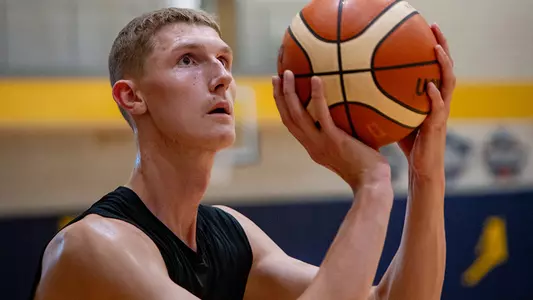
Defend the Block 403 – Marcus Møller Transcript
9/22/2026 4:00:00 AM | MGoBlue Podcasts
Brian Boesch • 00:00
It's normally best to have a forward-thinking mindset, focus on what you can impact. Control the controllables. As our late friend Greg Harden often said and later wrote about, that's not always easy, but Michigan freshman Marcus Møller has done it during challenging times. For a little while now, Møller refused a slow roll when arriving on campus. He was thrown into the fire more than expected out in Europe because of the Moustapha Thiam injury, and all of that did not faze him. It makes sense because of how he approached some adversity, not in basketball, but in life. Back in January, we learned that Mueller was diagnosed with testicular cancer. This was six months after verbally committing to Michigan and five months from when he was supposed to arrive in Ann Arbor to begin his college career. Fortunately, Møller announced he was cancer free in late May, and while arriving later than the other five incoming Wolverine freshmen, Møller did indeed join the program over the summer, albeit a bit delayed, more for visa reasons than health reasons.
Brian Boesch • 00:56
Møller is thankful for the support he has received and continues to receive, but he also has that mindset of looking ahead. The way he wanted to talk about it in our conversation I'm about to share was to discuss how his basketball work was affected and how it wasn't affected. Møller's goal is for the story to be about what he does on the floor, and he has certainly taken the proper early steps to do just that. Who knows what this season will entail for him, like many of these incoming freshmen. But what a story it could be, both because of his health challenges and because of the potential he shows as a basketball player and like he was during his cancer battle. Møller is locked in on what's next in his basketball journey, so let's get to know him a little bit. Here's Marcus Møller, another freshman profile for you on this week's edition of Defend the Block.
[music builds]
Jeff Laurence • 01:45
We're talking Michigan basketball. Welcome to Defend the Block, where we'll take you inside the basketball programs with interviews, analysis and so much more. Now is your host, Brian Boesch.
Brian Boesch • 01:59
We are continuing our conversations with Michigan freshmen. We've got the tallest one with us on Defend the Block and that's Marcus Møller. Marcus, thanks so much for joining us. Before we get to the basketball, I did want to just address obviously fans found out about your battle with testicular cancer and can you take fans through from a basketball standpoint, what it was
Brian Boesch • 02:17
like and how you were able to still stay involved and stay sharp with
Brian Boesch • 02:21
basketball during it and now after it?
Marcus Møller • 02:24
Yeah, of course Well, I got diagnosed in January and went back home to Denmark because I was playing back in Spain. So I went back home, Denmark, to get the treatment and stuff. And I was kind of determined that I would just, you know, try to do as much basketball and work out as much as I could and was possible because that's kind of a thing that I find a lot of joy in. So kind of to keep my mental state good and, you know, to stay positive through it all, I think it was really important for me to, you know, just try to get on the court and do as much as I could. So, I mean, throughout everything, I think I've been able to work out. And also, I think at especially the last couple of months before I came here, I was totally cleared and could just work out normally. So, yeah, I feel like I was at a good state and could kind of prepare myself the best way possible.
Brian Boesch • 03:16
Well, on behalf of Michigan fan, so glad that you were able to do that. And you've obviously overcome what you have. Coach Boynton told me that when you got here, when you finally arrived a little later than everybody else, you said, no, I don't want to be eased in. I want to just go. Why was that important to you? And how were those first few practices getting up to?
Brian Boesch • 03:36
Not game speed, but practice speed is
Brian Boesch • 03:38
probably a little bit different than just you. Some individual workouts.
Marcus Møller • 03:41
Yeah, for sure. Well, I came in a little late because high school overseas, where I was kind of finished a little later, so I had to get the visa done and everything correctly. But, I mean, when I came here, I've been already, as I said before, working out for like two months pretty intensively. So I just felt ready. And I mean, I've been looking forward to it and I've. I was, I mean, preparing for that moment and for my first weeks here. So, yeah, I just wanted to be thrown out into it. And, you know, I think that's also what I kind of got into, and that's how they threw me in. So, I mean, I was just glad that they gave me the opportunity.
Brian Boesch • 04:15
No doubt. Speaking of getting thrown in, the trip out to both Lithuania and Croatia, not
Brian Boesch • 04:22
only were you playing, but you probably
Brian Boesch • 04:24
got a few more minutes than expected because Moustapha Thiam went down early. Assess your performance. What do you think you did well out in Europe?
Marcus Møller • 04:32
Well, I think that, me personally, that I just. I mean, I tried to find my role on the team, and I wasn't really. I mean, I was always prepared to play. I knew that if Mustafa and, you know, JP Sterling, you know, there was a big rotation, so I was prepared to probably not play as much. But always just, you know, have it in mind that if anything happens, I'll be ready. And I want to, you know, when I get on that court, just give everything that I can. I think. I mean, it ended up pretty. Pretty well.
Brian Boesch • 05:02
Yeah.
Brian Boesch • 05:02
Nineteen minutes a game, five points, four rebounds per contest from you.
Brian Boesch • 05:06
What about for the team?
Brian Boesch • 05:07
What do you think of the team's performance over in those three games? How do you guys think you did pluses and minuses?
Marcus Møller • 05:13
I think we learned a lot. I think communicating and kind of team bonding, getting together as a team, and I mean, just learning each other's tendencies. You know, for me personally, I. I wasn't with the team as much as everybody else because I came in legendary. So for me, it was. I mean, I learned a lot about tendencies and, you know, learned decision making and what to expect from my teammates on the court. And I think that is really one of the positive things that not only me, but just as a team, we picked up each other tendencies and communicating with a bit really good and, yeah, getting to know each other.
Brian Boesch • 05:46
No doubt. You had some family members who were able to go out there for that trip. What was that like and how instrumental has your family been to you as a basketball player?
Marcus Møller • 05:57
My family has been, I mean, really important for me. My whole family. My parents and my two brothers, my two younger brothers. They came and I was really glad that they had the opportunity to come, you know. So, yeah, I think that they've always been supportive and said that, you know, if a bird can fly, they wouldn't cut the wings off. And so they've kind of just let me go. I left home to play in Spain, away from family, when I was turning sixteen. And that was also just, you know, they wanted to give me the opportunity to follow my dream. So they've always been really supportive.
Brian Boesch • 06:35
How long has basketball been your dream? When did you really start to sink into the sport?
Marcus Møller • 06:40
I mean, I started playing when I was nine. So I've played for like ten years. And I think that, I mean, it kind of got serious when I came in around youth national teams in Denmark, which was at, like, when I was like, fourteen or something. So that's where I really, you know, God, what can you say? The goal mindset that I wanted to take it as far as I can.
Brian Boesch • 07:00
When was the big growth spurt or were you always much taller than those around you?
Marcus Møller • 07:04
I was always kind of, you know, much taller than everybody. I think When I was fifteen, I was like seven foot and now I'm seven two. So the growth spurt probably came a little early. But yeah, I've always been tall, so I don't really know, to be honest.
Brian Boesch • 07:20
Sure. The thing I've noticed in watching you practice is that the three point shot, the, the stroke, the form seems very natural.
Brian Boesch • 07:28
It does not seem like you are
Brian Boesch • 07:31
in any sort of rush or anything. And I know in, in basketball now everybody has to be able to shoot threes or at least try to. So tell us about your development of the three point shot. How long have you been confident in that ability?
Marcus Møller • 07:44
I think, I mean, I've always wanted to kind of be, be versatile and be an all around player that, I mean, so if I had any things and you know, stuff on the court that I didn't think I was really good at, I would always try to work on it. And where I played overseas, we would always do like not mix it up too much cars and bigs, kind of, you know, put it together and say, all right, everybody do ball handling, everybody will shoot threes, everybody will kind of, you know, move with the ball. And also the guys were doing stuff under the basket. So I think, I mean my goal for my game is to be versatile and kind of, you know, I think it's also, you know, modern day, modern day basketball, good thing to kind of be able to do it all. So I try to just put myself in uncomfortable positions and work on the stuff that I'm not good at.
Brian Boesch • 08:31
How would you assess your strengths and
Brian Boesch • 08:33
weaknesses as a defensive player?
Marcus Møller • 08:35
Well, obviously my length is a strength and then I try to kind of get better at working at like defending the perimeter, defending cars. And I think that's, that's one thing I can probably work on, but I think I'm developing really well and I think I got the, the what, what's it called? Like, the potential? Yeah, the potential to work on it really well here because, because of guys like, you know, Elliot, Trey and guys that I'll be working out with in practice. So sometimes when we'd be switching on the ball screens, I come on and have to defend some of those. So I think it's kind of, you know, a good way to, a good opportunity to work on some of those, those things.
Brian Boesch • 09:16
What's it like when you're on the same team as guys like Elliot and Trey, their dynamic nature as guards, how
Brian Boesch • 09:23
do they make you a better player?
Marcus Møller • 09:25
Well, they make me a better player because they just see everything and I mean, I'm I'm not used to playing with point guards that can kind of, you know, when I look back to get the ball, the ball is already in my hands. So I kind of had to get used to that. And I'm. I still have to get used to that, but it's just, I mean, it's really nice to play with, and I think that it helps me grow as a player also. Sure.
Brian Boesch • 09:47
What have you learned from some of the other bigs, guys like Moustapha, JP, Jalen, Oscar? How have they poured into you to help you along in your early stages of college basketball?
Marcus Møller • 09:58
I would see, I would say the togetherness and the team chemistry and stuff and, you know, always been, you know, communicating and. And that. That is probably one of the main things. And then also just the physicality, like overall is, I mean, totally different that every box out and in every, you know, possession, it's just another level. So that's also a thing that I have to get used to, that I'm learning a lot from some of the other guys.
Brian Boesch • 10:23
What's on your to do list now until, say, the start of the regular season into November? What do you hope you can accomplish in your individual game between now and then?
Marcus Møller • 10:31
I hope that I can gain some more weight and kind of get stronger, and I think I'm on the right path. Coach Matt Aldred is working a lot, and I'm working a lot with him, so, I mean, just get stronger, get, you know, better defending, versatile, you know, perimeter. And, you know, I think I just. I just want to pick up as much as I can, so. Yeah.
Brian Boesch • 10:54
How long or how much have you enjoyed Ann Arbor and what are some of your favorite aspects of it so far?
Marcus Møller • 11:00
Well, Ann Arbor is really great. It's a college city, and I haven't, you know, experienced a college city like that before, so, I mean, it's just great to walk around on campus. You know, when I was in overseas playing, I did all my high school online, so I wouldn't, you know, I wouldn't come. I wouldn't meet a lot of people, usually on a daily basis. It would just be my teammates. So, I mean, it's fun to be out there, you know, go to class and see all my teammates once in a while, walk around on campus. So, yeah, it's. It's great.
Brian Boesch • 11:29
I won't allow you to say your friends and family outside of that. I know those would be at the top, but what do you miss most about Denmark?
Marcus Møller • 11:37
I must say, probably my dad's food, actually.
Brian Boesch • 11:41
Okay.
Marcus Møller • 11:41
My dad's food is. All right.
Brian Boesch • 11:42
Please elaborate. What's. What's his expert?
Marcus Møller • 11:44
His expert things. You make a really good chicken and then also salmon stuff. I mean, I'll try to pick up some of the stuff he cooks. So, yeah, I'll be making some. I made some nice steak yesterday. I'll be making some salmon once in a while. So I try to kind of take some of the things that I love from back home and his food and kind of copy it.
Brian Boesch • 12:05
Okay, so if your dad is at the top, right? One hundred percent top one out of ten. He's a ten. Where are you as a cook? How would you rank yourself?
Marcus Møller • 12:14
I'm confident. I would say like an eight.
Brian Boesch • 12:16
Okay.
Marcus Møller • 12:17
I can still learn, but I'm good. I'm a good cook.
Brian Boesch • 12:19
All right.
Brian Boesch • 12:19
So, yeah, you could get after your dad a little bit on that.
Brian Boesch • 12:21
You could beat him.
Marcus Møller • 12:22
Yeah.
Brian Boesch • 12:22
Who do you think that. How many people in your family do you think would like your cooking more than your dad's? Are you still not able to cut through that?
Marcus Møller • 12:30
I mean, I learned from him, so it's kind of, you know. I know. I don't know all the tricks.
Brian Boesch • 12:35
No, Marcus. No Marcus twist on it?
Marcus Møller • 12:37
I mean, the steak. I think I can make a better steak than my dad, to be honest.
Brian Boesch • 12:40
Okay.
Marcus Møller • 12:40
I made a really good steak yesterday. All right.
Brian Boesch • 12:42
Very well done. Well, Marcus, appreciate your time. Thanks for being so welcoming and open with us. We look forward to seeing you out there come November.
Marcus Møller • 12:49
Thank you for having me.
[music transition]
Brian Boesch • 12:58
Thanks so much to Marcus Møller. Really enjoyed that conversation.
Brian Boesch • 13:02
Also appreciate Tom Wywrot help in making it happen. Wanted to share some thoughts on both schedules that came out. We'll start with the women's side of things. I think it's really interesting that Michigan not only faces UConn during the season's first week, but that is the first game. No tune up beforehand. It is a Thursday, November fifth, opener for the premier program historically in women's basketball, UConn coming to town.
Brian Boesch • 13:28
Fired up for that one.
Brian Boesch • 13:30
The men, of course, will face UConn the next day in Boston. I think the big takeaway from the Big Ten portion of the slate is that Michigan hosts its two rivals, Michigan State and Ohio State, very early. Right around the holidays, Michigan State's a Tuesday, December twenty ninth tilt. And then January seventh, Ohio State comes to town. That is a fascinating dynamic early in the season. The double play with Michigan State is back. That's the only one that the women have with the eighteen game conference schedule. So the return matchup with the Spartans is the regular season finale and it'll be a road heavy finish for the Maize in blue. Their Los Angeles trip comes late January, early February at USC on January thirtieth at UCLA February second. That starts a stretch of five of the final eight for the Wolverines on the road with back to back roadies at Minnesota and Wisconsin.
Brian Boesch • 14:25
So no question a challenging finish and a rival heavy start for the women's side. On the men's side, obviously interesting that we'll get three chances to watch Michigan in exhibition play, two at Crisler and then the one against Houston out in Grand Rapids. Excited to get out there and see the Wolverines play in state.
Brian Boesch • 14:45
But away from Ann Arbor, the women
Brian Boesch • 14:46
only have one exhibition. That's on October twenty ninth against a non D one program. You look at the Big Ten slate, hey, I think it's pretty cool that they're mixing it up a little bit with the fact that the final game is in Columbus and it's not a Michigan State matchup. But you want to talk about a massive week. February ninth, home against Illinois, february thirteenth, home against Michigan State. We'll see what this team looks like at that point. I certainly think that the challenging non conference schedule will help Michigan prepare for that type of a week with Michigan doing a lot of travel in the non conference. But boy, Illinois and Michigan State a home stand that's going to be wild. Again, the Wolverines on the men's side, they have a pretty road heavy finish. Four of their final six. After that stretch away from Crisler, the lone home games against Iowa and Maryland, but to finish with arrivals at Michigan State and then nine days later at Ohio State.
Brian Boesch • 15:42
You start.
Brian Boesch • 15:43
I mean really. Gosh, you start with that Los Angeles trip and there isn't a single gimme on that schedule. With the Big Ten slated to be yet again really, really tough. So fired up for it, excited to see what these two teams can do and nice to always know when we're going places, where we're going. Going to be a lot of fun for both the men's and women's teams. All right, that's it for me, Brian Boesch. Thanks to Marcus for stopping by. We can't wait to get that schedule locked and loaded for the upcoming season, but we'll keep you covered every Tuesday here on Defend the Block. Until then, thanks for listening everybody. And go Blue.
[music builds]
Jeff Laurence • 16:15
Thanks for listening to today's edition of Defend the Block, part of our Michigan Athletics Podcast network, M Go Blue Podcasts. The preceding has been a Learfield presentation of the Michigan Sports Network.