In the Trenches 586 - Zack Marshall, Freddie Whittingham Transcript
5/13/2026 5:43:00 AM | MGoBlue Podcasts
Jon Jansen • 00:00
Well, you guys are in for an absolute treat today because if you like tight end play, and we love our tight ends at Michigan, Zack Marshall is going to join me and trust me, it's a, it's a well versed interview. He is a student of the game. You're going to love everything that he has to say and we're going to follow that up with the tight end coach, new to the program, Freddie Whittingham. All to come on in the Trenches.
[music builds]
Jeff Laurence • 00:27
Welcome to the official podcast of Michigan Football in the Trenches with Jon Jansen. Presented by Meijer. Presenting sponsor of the twenty twenty six Michigan football season and proud supporter of hundreds of local sports teams across the Midwest. Nobody covers Michigan football better than the two time captain, national champion and Michigan athletics hall of honor inductee.
Freddie Whittingham • 00:49
Zack Marshall is a kid I recruited out of Carlsbad High School and actually at Utah thought that we might be his selection. And then Michigan kind of late and offered him and he couldn't say no to the business school and the program and everything, but he said, coach, you're in my top two. And I knew at that point that, okay, he was probably going to Michigan.
Jeff Laurence • 01:10
This is in the Trenches presented by Meyer. Once again, here's Jon Jansen.
Jon Jansen • 01:17
Joined now by senior to be Zack Marshall. Zack, thanks for joining me. Always great to have you on the podcast. And I mean, hey, you've seen a lot of change here at Michigan. You've weathered all the storms. What's this winter and spring been like for you?
Zack Marshall • 01:33
Yeah, this is the first time I've ever missed a practice here. Right. It's a weird dynamic, right? To be kind of an old guy knowing that, yeah, I'm gonna play next year, but I can't like show it right now. It's almost just this waiting room of being like, okay, I'm ready for when I can get back out there. But it's like, let's, let's just invest in the people that you know haven't had as much experience, invest in the program as a whole and getting everyone ready to go win a national championship.
Jon Jansen • 02:06
So it's interesting that you say that about being dinged up in the spring and not being able to go because throughout the course of your career, you've been one of the most healthy tight ends. You haven't missed any games, you haven't missed any practices. As you mentioned, now everyone's slate is wiped clean and everyone is getting a new look from a new coaching staff. How have you been able to impress this coaching staff? Obviously they can look at the film. Yeah, but how are you impressing upon them what you can provide this team, this program, without being able to be on the field?
Zack Marshall • 02:37
I think my ability to learn the offense right, and be able to have a bird's eye view of it, not just a face mask view, right. I always. I always think of it as, like, could I coach this offense? That's the kind of expertise I want to have in it. Like, could I teach a freshman who walks in tomorrow? Like, we got Mason Bonner coming in in summer. I want to get so good in the next four months that I could teach Mason anything he needs to know. Not just about the quarter or the tight end position, but if he was playing quarterback, how would he go through this read? Why do you need to take your time on this route? Because, okay, you're actually a third person in this read. We can't show up too early. We can't get in that window. Like, being able to have that intellectual understanding is huge to me.
Jon Jansen • 03:21
That's not an easy concept for freshmen to learn. When did you finally understand, I may be the third or fourth option on this route, but how it affects the defense, affecting who's supposed to be the number one target or number two target. When were you able. When did the light come on for you to understand an offense like that?
Zack Marshall • 03:40
I think between my sophomore and junior year, right, I've had a different old coordinator every single year, which is a funny stat, right? Four years, four offensive coordinators. Um, but just to be able to. Because the first three years it was a similar offense. I wouldn't say the same offense, right? From. From a very Harbaugh centric to Sherrone and what we grew into a chip, right? Thinking of those, those three kind of unique, yet similar, like being able to do that. Bird's eye view only happens when you understand football as a whole, right? Like not just your terminology, but. But how defenses run. Okay, well, we're going to run the star concept, right? Some people will call it star, some people will call it snag, some people call it spot, right? Like, you think of. Of it in this way and you're like, all right, this concept where you have a snag route, you have a corner like those things, and being able to, like, understand from a quarterback's view, okay, how.
Zack Marshall • 04:35
How this plays out is all dependent on where you end up in your spacing, right? Where. And then that light kind of flicked or turned on when I was like, oh, well, if I just think of it as a quarterback the entire time, like, I'm playing Madden. It actually makes a lot more sense to think of it from the entire offense as a whole.
Jon Jansen • 04:56
So, so having the understanding of those three offenses, now the fourth offense that you've been in, what do you see in this offense and what sets it apart from those other three variations?
Zack Marshall • 05:08
Yeah, yeah, horizontal. Let's just, let's get the cat out of the bag. I think everyone knows this. If you watch Jason Beck's offense, right, it's like it's all about horizontal spacing. And yes, we can beat you down the field, we can run the ball in the box too. But the ability for the jet sweep to just open up or the ability to be able to get on the perimeter quick screens, now the screens are different than screens that people think of, right? Everything's an R-P-O, everything has a second option, everything has a QB pull press. Having that versatility going horizontal is so different than anything we've had before. And it's simplified to a point where you're able to just go out there and play, right? It's very, once you got it, you got it. It's not as, I wouldn't say like there are very, very technical parts about it but you can go out and learn the offense in a, I mean, I'm not going to say in a day but like learn what you're doing and get rolling.
Zack Marshall • 06:08
And it's a lot less dependent on, on, on being ultra, ultra specific. It's about getting open, playing a little bit of backyard football, having, having versatility in what you do, not just sitting in one place. Like those kind of things are so different than a, some of the pro style offenses that you see, right? Like there's a lot of times in pro style offenses you're running to get covered. In this offense you're never running to get covered. You are trying to get open, you're ready to get the ball. All five eligibles can get the ball. And the quarterback, yeah, he can run that ball too. Like no matter what in these, Jason
Jon Jansen • 06:45
Beck's offense there, gosh, there's a lot. So first I want to get to is what's that mean for the tight end position? Now that hey, maybe you were a third or a fourth option, but if all five guys are eligible to get the ball, what does that mean for the tight end?
Zack Marshall • 06:59
I mean you've seen it, right? They'll bring in an extra alignment and use a tight end as a, as a, as a wing or even put him in the backfield or I don't know how much of this offense you've watched from, I don't know, your practice. Exactly. So the tight end can line up anywhere, like, truly anywhere. Yeah, we'd say that in the old offense. Like, yeah, we'd put Colston out one on one, but you know, we wouldn't put Brady out one on one. Right. In this offense. Yeah, we could end up with Brady out there. Like, it would be awesome. Right? I'm just trying to use, like, familiar faces for Michigan fans to understand. Like, the way that this offense is built is for you to get your best people in the best position to go win the football game. Like, I mean, if the tight end is the best person to take a jet sweep, we're giving it to the tight end. You saw it with Oregon. I'm not going to say this is that similar to like Dan Lanning and what they're doing over there.
Zack Marshall • 07:52
But like, if you think about your best players and want to get them in the best positions and you were to just draw plays for them, that's what this offense is. It's so fun.
Jon Jansen • 08:04
So I'm curious then, because you're removed from practice right now, you're taking all this in. Do you feel it'll be different when you have this base of knowledge? But then what's it like in terms of execution when you get back on the field?
Zack Marshall • 08:18
I mean, at the end of the day, it's technique and fundamentals, right? Football's football block, run, catch and hit. Right.
Jon Jansen • 08:25
I mean, don't make it too complicated.
Zack Marshall • 08:26
Don't make it too complicated. I think when people overthink the okay, on this play, I'm going to do this, this, on this. Like, if you're going to block that guy, put your body in front of him, put your hands on him and don't let him touch the guy with the ball. Like, at the end of the day, that's what you got to do.
Jon Jansen • 08:41
So how did you see this offense develop with Bryce or whoever's running at quarterback in any group with, you know, a number of different pieces that are new to, to Michigan football, but everyone's new to this offense. How did you see the offense grow throughout the entirety of spring ball?
Zack Marshall • 08:59
Yeah, I can speak to the tight end room specifically. Like, our fullbacks aren't just fullbacks. Our tight ends aren't just tight ends. Right, because we, we don't have a fullback on our roster. You know what I mean? It's a tight end room. It's where all the tights. Right. So it's like this beauty of Being able to use people in ways they've never been used before. And just kind of like when I showed up, they put me in the backfield and played fullback. Yeah, I'm six four. Probably wasn't a great idea, but like I was willing, I was willing to try to run through somebody. I didn't do that well sometimes. And then they were like, oh, maybe you're better on the line. Maybe I am. But like, that kind of versatility is something that we've never had before. And I mean you're seeing it in the, in the wide out room. You're seeing in the running back room with Savion, right?
Zack Marshall • 09:46
They'll line them up at wide receiver, they'll line Jay Marsh at wide receiver, they'll line up Andrew Marsh at the, at the backfield, they'll put Jamie at number one, the slot at tight end, put JJ at tight end, at the slot outside. Like everyone truly gets. There's no like distinct xyz, H, F roles, right? Like it's, it's so unique in that
Jon Jansen • 10:09
way having a guy like jj, even though he's much younger than you, but he was with this coaching staff and maybe not with, with Coach Beck for a long time. But is it a benefit to having some pieces that understand the offense more going into spring ball and coming out of spring ball?
Zack Marshall • 10:28
Totally. My favorite thing to do is. This is going to sound terrible. I used to, I would watch him on the old Utah tape, right? His, his game against BYU had a big like, chop route, catch, right? Like a fade route. His game against Arizona State, he didn't play much, right? And like kind of going into those like little intricacies like, yo, why'd you do this? Or whether I ask him or not, right? Mentally taking the note, okay, well he did this back then, and then yesterday he just did this. Okay? So he's, he's learning maybe the difference in how he wants to get open and maybe you don't need to show up that fast. Like he's learning and seeing his development. You can a not make the mistakes that he might have made, whether I know if they're mistakes or not, right? Like, just see how he's doing it now because you know, he's trying to get better. You can see that.
Zack Marshall • 11:19
You can be like, okay, cool, now I can take what he's now done and eliminate the thing that might have not worked, right? So he's, he's evolving. You can watch him evolve and be able to kind of evolve your game around that.
Jon Jansen • 11:34
So you specifically, when you get back on the field from last year to next year, what is it that you want to be better at?
Zack Marshall • 11:40
Ooh, that's a. That's a great question, because I want to say everything, right? Like, no one. No one says they don't want to get better at football, right? As a whole.
Jon Jansen • 11:48
But if there was one.
Zack Marshall • 11:49
If there was one, focus. Just sheer domination in the run game. Like, I felt like a lot of the time, yes, I was. I was winning. But winning is not enough to go play in the NFL. To be able to walk a D lineman three, four yards off the ball, that's what you need to go play in the NFL. And that's my. That's my goal. I mean, playing the NFL well, my goal's in order, right? Go in the Big Ten. That's our. That's our team goal, right? And then go in the cfp. Go in the national championship. Those are the first. First goals that anyone on this team should have. Then your personal goals come second. For me, it's. It's. Go be all Big Ten. Go win the Mackey. Go get drafted. I mean, we're at that point, right? Something to say that I would never have said my freshman, sophomore, junior year. But now I feel like I'm in a position to put myself in those conversations and just go after them.
Jon Jansen • 12:43
Is there an advantage of looking at a guy like a Colston Loveland who has done those things? He's now going into his second year in the league to be able to have those conversations with them, to be able to look at his career path and try and mirror some of what he's done.
Zack Marshall • 12:58
I've got four of the best, like, models of what it takes to do that in Colson. AJ Max Bredeson and Marlin Klein, right? Marlin is just. Was the true dominant run blocker. Like, he could move a person off the ball. Bredeson, fearless, won every single time. If I needed somebody to, like, do construction without any tools, it would be Max Bredeson. Straight demolition, right? Like, that's. He's. He'd figure it out, and he'd be perfect for demolition, and he'd go put up a dorm room by himself. You know what I mean? Like, he's insane.
Freddie Whittingham • 13:36
Next.
Zack Marshall • 13:36
AJ the true, like, do everything. Win in the run game, win in the past game. Didn't make anything too hard, right? Nothing was too hard for him. Nothing was too complex. I mean, you saw him insert block against. Who was it? It's Michigan, Minnesota. Oh, my gosh. I can't believe I pulled that like three years ago, he was insert blocking against Minnesota then. And then you have like Colston Loveland, who. His freshman year on the goal line against Penn State. I mean, he, he helped us win that game. You know what I mean? Like those kind of things. Like, yeah, legit dudes who have like that. I keep on saying versatility, but there's no other way to say it. You're a tight end. That's what you get paid to do. Be versatile. Be able to be a six lineman and a fifth wide receiver. That's your, that's your goal.
Jon Jansen • 14:26
And when, if you were to tell a freshman coming in, you mentioned already you're going to be mentoring some of these guys that are coming in, what are the priorities that you tell those young guys? Because everybody wants to catch touchdown passes, everybody wants to be out in routes. But a large part of winning football is being like you talked about that six offensive linemen. Where are the priorities as a young player coming into Big Ten football?
Zack Marshall • 14:51
My freshman year I focused on trying to get on the field as a tight end. And then my sophomore year I focused on getting on the field. What did that mean? That meant special teams. You get so much better at football as a whole playing on special teams. It's the king of fundamentals. It's running, it's hitting, it's tackling, it's blocking. And if you do those four things right, you will get on the field as a, As a tight end. Yeah. Everyone can catch. They didn't recruit you here because you catch. They recruited you because you're fast, you're big, you're able to become a great tight end. They're not recruiting you just because, oh, you made one catch and one skills camp or what is it? Rivals. Rivals, right. You made one big catch in a rivals thing. Yeah. No, no, no. That's not what recruiting is. That's not what football is. Football is about running, hitting, tackling and blocking.
Jon Jansen • 15:44
Well, and I'll tell you this, just a little piece of advice, it doesn't change when you go to the NFL, because if you want to make a roster, the difference between those guys, some that make it, some that don't, is the willingness and the ability to understand special teams concepts and be able to perform them. And before I let you go, you mentioned the goals that every individual should have here. It's winning the Big Ten championship, CFP and winning a national championship. What is this team doing? Or do you think this team can accomplish those goals one hundred percent.
Zack Marshall • 16:18
From a physical standpoint, we're the strongest, fastest and most conditioned than we've ever been. Hats off to the strength and conditioning staff. They've done an incredible job with us already, right? We came in, we, we had deficiencies. There's no doubt about it. Now, were we uniquely strong in other areas? Of course, everyone has their strengths and weaknesses, right? Like our old staff versus our new staff. But being able to kind of encapsulate all of the good that we've gotten. Take the old training with the new training. Because a lot of the way that it's been the last three years, it's. It's been so similar that if you told someone, okay, but I learned this from them, there would be no correction. Now. It's, well, I think that's great, but we've been doing this for a long time. We've seen this happen, right? So we have so much breadth of knowledge to be able to improve and have improved that we can make that kind of run.
Zack Marshall • 17:25
Now, from a football perspective, no one's going to know what we're doing, which is pretty fun, right? Like, a Jason Beck offense in the Big Ten isn't something you're very expected to see. And, I mean, obviously we can't sit here and say, yeah, we're going to win every single game, blah, blah, blah. We want to. We're going to work our butts off to go do that, but to be able to have something new, right? We're not running the same duo concept that we've ran.
Zack Marshall • 17:52
We're not running the same. It's. It all blocks up different, but it's. It's the same, but it's still. It's. But it's coached different. So we're working to different people. And that, like, nuance and newness of it is going to mess with other people's defenses.
Zack Marshall • 18:07
Now our defense is also so different here now. I mean, we used to work, play so much quarters and so much. I mean, so much blitz with Wink, you can. You can probably pick that up, right? Like, yeah, the differences are so unique, but are going to be executed so well that this is the year of any year to go do it.
Jon Jansen • 18:26
Well, Zack, I appreciate it. Best of luck as you try and pursue all those goals. So thanks for your time.
Zack Marshall • 18:31
Thank you so much, man.
[music builds]
Jon Jansen • 18:40
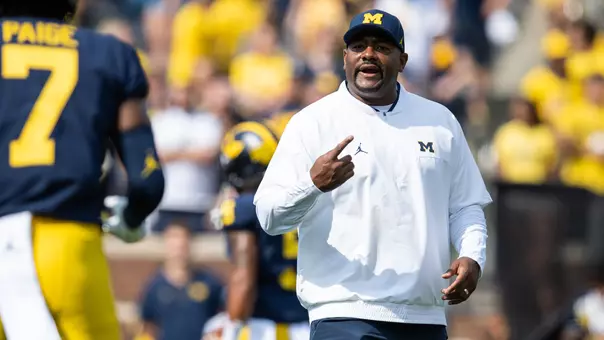
Joined now by the tight ends coach here at the University of Michigan, Freddie Whittingham. Coach, thanks for joining me. And I mean, I'm asking everybody this right now. Your reaction to Ann Arbor, to being in Michigan, because you spent a lot of your time out West.
Freddie Whittingham • 18:58
Initial reaction, man, it was cold when we came in here. At first, I think it was like, you know, maybe a record cold spell there for a little bit. But then, you know, as things progressed and I got to explore, you know, the city a little bit, get downtown, eat at some of the nice restaurants. I love it. It's a. It's. It's the ultimate college town. And it just has this great vibe, great feel, you know, is out over the weekend of the spring game. I think there must have been graduation or something going on because there was a lot of parents here, students, a lot going on. And I just think it. I love the vibe. Great vibe.
Jon Jansen • 19:35
Let's dig into your room, because eventually I do want to get into your coaching history because you've got a very unique one. But let's talk about the tight end room right now. When you took a look at the roster as it was constructed even before any of the additions in the transfer portal, what was your initial reaction to that?
Freddie Whittingham • 19:53
Yeah, so there was a familiar face in there. Zack Marshall is a kid I recruited out of Carlsbad High School and actually at Utah, thought that we might be his selection. And then Michigan came in kind of late and offered him, and he couldn't say no to the business school and the program and everything, but he said, coach, you're in my top two. And I knew at that point that, okay, he was probably going to Michigan, but no, came in. First thing that I did, first day here was watch film. Pulled up all the snaps that each one of the guys in the tight end room had from last season and watched those, talked to the coaches that were here. Tony Alford was here, Lou Esposito was here. Coach Coombs had been here for just a bit, you know, kind of got there. Oh, and Freddie Jackson. Can't forget him.
Zack Marshall • 20:45
Freddie Jackson been here for a long time.
Freddie Whittingham • 20:46
Yeah, he probably had. He probably had the most information on. On the guys and so kind of got, you know, their. Their description of what type of players they were. And so I kind of saw. I got two fullback types and. And three, you know, true traditional tight end types and liked, you know, some of the stuff I saw on film. I knew they were graduating or. Or at least, you know, two guys moved on to the draft in Max Bredeson and Marlon Klein and watched their film as well and kind of had wished that, you know, both of them may have had another year to stick around or chosen to stick around. Yeah, but I'm excited about the room.
Jon Jansen • 21:24
Everybody always wants to talk about depth and you just mentioned all the guys that are in that room and. But you have different styles of guys in that room. Where is this position in terms of depth?
Freddie Whittingham • 21:35
I think the, the depth is strong. You know, the two guys that are the fullback types, Jalen Hoffman and Eli Owens, both had great springs, both had a lot of production this spring, feeling good about where they are, to be able to help out in their role. And then, you know, Zack was not able to practice, recovering from a shoulder surgery that he had in January. Um, but Hogan Hansen, he, he came on really strong. He showed himself to be a threat in the, in the passing game. Big target, good hands, goes, goes up high and gets the ball. And then Deakon Tonielli also, he has some real physical traits. He can run, he's athletic. You know, he, he put some good tape out there too, so felt really good about the depth of the position.
Jon Jansen • 22:18
Is it difficult when you have one position by label, but different styles in that position to coach them, they need different things, they need different reps. What are the challenges that you face with different body types, different personalities, and different expectations for each individual?
Freddie Whittingham • 22:35
Yeah, I would say that maybe one of the, you know, really only challenges is that when it comes to individual drills, you know, the individual drills for a fullback are going to be a little bit different than those of an inline tight end, and individual drills for a move tight end, you know, kind of a flex Y type, are going to be a little bit different. But, you know, we, we, we really structure our offense to spend a lot of time in team. So at that point it's just, you know, focusing on the film and the fundamentals and technique that, you know, that you see in the film and, and altering your, your indie to really work on, you know, those drills that match up with the assignments you're asking them to execute.
Jon Jansen • 23:20
What did. Where is this position group and the guys and maybe it's individually. I'm sure it is. Where are they coming out of spring and what, what needs to happen between now and the start of fall camp?
Freddie Whittingham • 23:33
So coming out of spring, I saw some, some things that we improved at, got. Got good at, you know, with a lot of our offense, we're going to be blocking perimeter runs. You know, we're trying to circle the defense and, you know, in one direction, other direction, using a QB read and power or, or counter. And so they need to be good at fitting up in space. All right, so saw a lot of progress with that type of blocking then a lot in the, in the throw game, you know, a tight end really has to get open in tight spaces and, and, and also be physical at the top of the route in those tight spaces. So I thought we got made a lot of progress in that area too. You know, when you to catch those quick, you know, six seven yard routes that can turn into eight, nine, ten yards with a good, you know, run after catch, that was something we made a lot of progress in. And then you know, in, in pass protect, we kind of have a unique pass protection here where, where we get six man pass pro using an additional tight end.
Freddie Whittingham • 24:38
Sometimes that can be a sixth alignment, sometimes it can be a tight end. So we worked a lot on pass pro so that the, the tight ends would be in a position to do that. And yeah, so you know, play action pass is where you, where the tight ends really eat in the passing game. So that, that to me is, is going to be kind of the core of what we do.
Jon Jansen • 25:00
When you look at this group and you look at this offense and I guess it would be best because you've got a lot of guys that you're inheriting, not a lot of transfers in this group. So the offense comes in. How do this group of guys fit the offense and then how much does the offense need to fit the group that you're inheriting?
Freddie Whittingham • 25:21
Yeah, so no transfers in the group. You know, we came in and there was not really a spot for a tight end transfer. So. And I didn't feel the need to go out and get one, you know, late in the process. So when it comes to, there's, it's kind of a two way thing. If you know a player can do something really, really well, let's say it's running a seam bender route. Okay. Then, then you're going to design the offense to utilize that player in a, in a concept that, that uses what they do really well. And, and on the flip side, you know, you look at what they do well and build, scheme around that, build plays around that. So you're going to have a clustering. The six guys are going to remain the same always pretty much are the five, zero linemen and then the quarterback and then from there you got the five skill players and you can mix and match, you know, two backs, two tight ends, you know, four receivers, however you want to do it and really utilize what the guys that are in that personnel group do best.
Freddie Whittingham • 26:29
So, so it's kind of a back and forth between, okay, identifying what they do really well and making sure we leverage that with the concepts that we design around them. And then also you Know, designing concepts around, you know, what. What we already know that they can. They can do.
Jon Jansen • 26:48
One of the things that I really like to do, and I know our fans like, is to get to know the coaches a little bit better. And there's a lot of. For our fans to take in with such a turnover in the coaching staff. And your history, I mentioned it's a little interesting because you were a running back at byu. You spent some time. Was it with the Rams?
Freddie Whittingham • 27:06
One season on the practice squad with the Rams. Yep.
Jon Jansen • 27:08
And then you went to the World League and you played for the San Antonio Riders. I'm curious, what was that experience like playing for the Riders?
Freddie Whittingham • 27:18
Yeah, so that was the very first season of the World League inaugural league, and they had some financial support from the NFL. However, we showed up to training camp, and there was not enough gear for about fifteen players. So that kind of delayed our training camp in San Marcos, Texas. Mike Riley was the coach, you know, there at San Antonio, went on to become the head coach of the Chargers, Oregon State, you know, a variety of other places. And so it was kind of. It was great because there were a lot of guys that didn't quite make it in the NFL that got another chance to play ball. And it, you know, I wasn't there long before I realized, you know, this is probably my swan song, I'm gonna be finished after this and go get a real job.
Jon Jansen • 28:07
Well, and you mentioned a real job. You were, and I say this in air quotes, nobody ever works at nine to five anymore. But you were in a nine to five world for nearly two decades.
Jon Jansen • 28:18
What took you away from football? And then on the flip side, what brought you back to football?
Freddie Whittingham • 28:23
Yeah, so I was definitely part of a football family. My two older brothers had played at BYU before me. My father had had been in the NFL when I was born and then had transitioned to coaching when I was about six years old. So football is all I had ever known. And my two older brothers also went into coaching as soon as they were finished playing. So when I. When I was all finished, I kind of just didn't want to go into the default of being a football coach. And I consulted with my dad and my two older brothers, and all three of them were like, yeah, go do something where you have a little bit more time with your family, a little bit better job security. And so I started looking for what life after football would be. And I found a spot with a college textbook publishing company. It was a division of Simon and Schuster, and it kind of fit. And you Know, I did well.
Freddie Whittingham • 29:17
Took various promotions, moving me to New Jersey, Arizona, California, and spent nineteen years in that business. And it was. It was a great run, and I. And I loved it. But then, you know, Kyle had an opening at Utah for a director of recruiting. And I had been thinking about it for a couple of years, just like, man, you know, I kind of miss football. Did I make the right decision, you know, not going in that direction? And I'm not gonna lie, it didn't. It kind of helped that, you know, the, the income you could make in college football had escalated quite a bit since those days. And so he had that opening, and my company, I was with mcgraw Hill at the time, had just been bought by a private equity firm, and they replaced my boss, who was probably the best boss I've ever had. No, no, you know, no offense to Kyle, but best boss I ever had in that business. And, you know, they.
Freddie Whittingham • 30:17
They let go of him, you know, and replaced him with a guy that, you know, kind of drove about sixty percent of the people to. To move on. And so it was just. It was just timing, you know, it was that, that, you know, that event at McGraw Hill, plus the opening at Utah. And I'm like, I made a leap of faith and took a big, big pay cut and went to work in operations, and I did that for four years. But I had told Kyle that, like, I'm doing this to attempt to get on the field at some point. And so four years later, the tight end job opened up at Utah, and it was a good fit. So I moved in in twenty sixteen.
Jon Jansen • 30:56
What's it like working with family? Because you've got a boss that's a family member, you've got another. What is a nephew who's an assistant coach along with you, there's an interesting dynamic of there's. There's family time and then there's work time. How's that? How do you guys manage that?
Freddie Whittingham • 31:18
Yeah, so we don't really talk about football in any type of family gathering. You know, usually if it's brought up, it's going to be brought up by somebody else that's there that's going to be asking questions. But, you know, among ourselves, it's not really brought up in those type of gatherings. But, you know, for me, you know, when I was at Utah, it was me as his brother, and just like a lot of, you know, brother relationships, I think he. And he admitted this, like, I. Probably harder on you than I am on any other guy. Sure. And I got that, and I appreciate It. I didn't resent it at all. It's like, I thought it kind of comes with a ton territory and I think a lot of the other coaches would say the same thing that I worked with there. And then coming here, being able to work with my nephew, that was pretty cool thing because Alex and I, I mean, we're obviously a lot of years apart, but he was born on the same day I was born on.
Freddie Whittingham • 32:17
Always had a good relationship with him. We got a lot of similarities. And so for him to come from Kansas City with his NFL experience, you know, I always ask him a lot about that. I went to visit him there a few times to do some professional development with the Chiefs, you know, see how Kelce ran. And so now it's just, it's awesome that, you know, we're here in the same building together and probably can have more of a kind of like a, you know, friendly relationship with Alex. Kyle's still the boss, you know, so. But I can hang out with Alex and go get a burger know in downtown Ann Arbor.
Jon Jansen • 32:57
When you look at your career and whether it's coaches you played with, bosses that you've already mentioned, what is it that everyone brings a unique traits and something to their coaching style? What did you learn as a player? Also as somebody in a nine to five world, but now as a coach, what have. How has that shaped you as a coach?
Freddie Whittingham • 33:21
Yeah, I think that what. What I learned is that two main pillars, okay. The first thing is when I was working for the publishers and I became a manager that hired a lot of people, I figured out that the best way to get high performance and results is to hire the right people. And that's the same in football. The best way to get performance and good results is to recruit the right players. And so that's lesson number one. And, and number two is that in order to teach concepts that can be complex, you've got to be able to distill them into and simplify them and be able to communicate them clearly to players so that they understand them and know what it is that you're asking them to do clearly so that they can go and do it. And I would say that my style is to. To instruct, all right, evaluate how they're doing it and then correct and demand that they do it the way we're asking them to do it.
Freddie Whittingham • 34:25
So to me, it's my. Everything's on me. I've either not taught it correctly, all right, I'm not evaluating it correctly, or I'm not demanding that they do it. So ultimately, everything you see out on that field is going to be, you know, my responsibility, my accountability.
Jon Jansen • 34:42
If there's anything I've learned about this coaching staff, and especially about Coach Whittingham yourself, is that there is an unbelievable competitive drive. I also have brothers of my own, and I know that the competition runs deep outside of football. What are you and Kyle most competitive about? And maybe it's even something from your childhood. What is it that just. You just. You can't let go, that you guys are always competing in
Freddie Whittingham • 35:12
really two, two, two hobbies. So tennis. And he got an earlier start in tennis than I did. Both of us started after we were done playing, but he was done playing six years before me. So early on, the win loss record was heavily in his favor. But then I started playing more and more and more and he kind of like stayed the same, and that has flopped. I've won, you know, in the last, I don't know, eight to ten years. I've won a lot more matches. And then the other thing was skiing, and that's where I got a head start on him. My mom started skiing in Utah when I was eight years old. For whatever reason, he was, I guess what, twelve, fourteen, he was involved in sports and stuff, football, baseball, so he wasn't skiing. And then he got into it later and he thinks he's as good as me. And I will admit he's closed the gap, but he's still not quite as good of me.
Jon Jansen • 36:08
Hasn't flopped like. Like tennis did?
Freddie Whittingham • 36:10
No, no, had that. That has not flopped, but he has closed the gap quite a bit. And, and in golf, it's no contest. He.
Zack Marshall • 36:18
He.
Freddie Whittingham • 36:19
He can. He beats me soundly.
Jon Jansen • 36:22
Oh, I mean, well, I'll give you my tip on golf. Just a swing harder.
Freddie Whittingham • 36:26
Yeah, swing harder. Yeah. The problem is he, he. He became obsessed with it several years ago and started playing a lot. And I still play in a scramble, you know, a few times a year.
Jon Jansen • 36:37
Yeah. Yeah. That doesn't. In that game, it's not. It doesn't constitute improvement.
Freddie Whittingham • 36:42
Yeah. But it doesn't soften. Soften the competitiveness at all. I'm not, you know, I still don't like losing at anything to him.
Jon Jansen • 36:49
Yeah. Well, Coach, I appreciate your time. Thanks for sharing some of that competitive nature between you and Kyle and we'll look forward to getting to know you more.
Freddie Whittingham • 36:57
All right, thanks.
[music builds]
Jon Jansen • 37:05
Well, thanks to tight end Zack Marshall and tight ends coach Freddie Whittingham. Always love to get a chance to talk to some of the guys that have been here, get their perspective as players. Also the new coaches, what's this offense? What what's their position group group going to look like? And this tight end group is loaded with talent, as we have come accustomed to here in Ann Arbor. It is a loaded bunch of tight ends going to get a lot of production, hopefully a lot of touchdowns, a lot of receptions. But this is a group that's going to set the edge as well. So for everything that's going on in and around Michigan football, keep it locked in here on in the Trenches.
[music builds]
Jeff Laurence • 37:43
Thanks for listening to this edition of in the Trenches with Jon Jansen, presented by Meijer, presenting sponsor of the twenty twenty six Michigan football season and proud supporter of hundreds of local sports teams across the Midwest, in the Trenches is part of our Michigan Athletics Podcast network, M Go Blue Podcasts. The preceding is a Learfield presentation of the Michigan Sports Network.